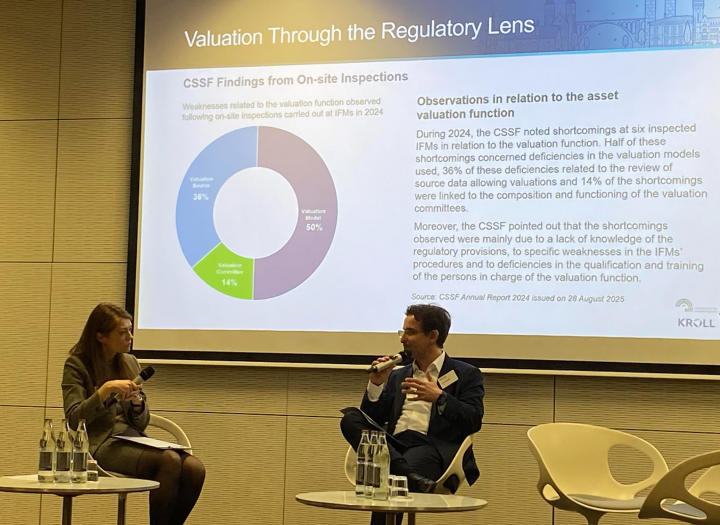
Valuation sits at the heart of Luxembourg’s private markets ecosystem, yet supervisors remain unconvinced that current practices are consistently robust.
Speaking at an event organised by Kroll and the Association of the Luxembourg Fund Industry, the CSSF flagged shortcomings in the review and approval of valuation models at investment fund managers, underlining that governance, documentation and independent challenge still require closer attention as private assets continue to scale.
Valuation is a core process in the alternative investment fund industry and a central concern for market participants in Luxembourg. Its importance has increased as professional portfolios allocate more heavily to private assets and private markets are gradually being opened to a broader investor base, including retail investors.
“The demand for high-quality, frequent, and independent valuations has never been greater. Regulators expect it, investors require it, and markets depend on it.”
Elena Moisei, Kroll
 “Some people collect stamps, others collect coins, and then there’s us valuers: we collect discount rates,” said Elena Moisei, managing director, portfolio valuation at Kroll, referring to a key metric used for determining the value of privately-held investments.
More than just a simple tick-the-box exercise, valuation has become increasingly important over the last decade. And with Luxembourg being a European hub for private capital, valuation is particularly crucial for the industry. “The demand for high-quality, frequent, and independent valuations has never been greater. Regulators expect it, investors require it, and markets depend on it,” said Moisei.
Shortcomings in valuation models
This increased focus on valuation is also evident in the CSSF’s annual report, she pointed out, where the word “valuation” appears some 60 times. Twenty-five percent of observations following on-site inspections carried out at investment fund managers (IFMs) in 2024 were related to the valuation function; an additional 25 percent of observations were related to internal control functions.
The regulator also noted shortcomings at six inspected IFMs related to the valuation function, according to the report. “Half of these shortcomings concerned deficiencies in the valuation models used, 36 percent of these deficiencies related to the review of source data allowing valuations and 14 percent of the shortcomings were linked to the composition and functioning of the valuation committees.”
“There’s still room for improvement when it comes to review and approval of valuation models.”
Alain Hoscheid, CSSF
 “There’s still room for improvement when it comes to review and approval of valuation models,” Alain Hoscheid, the CSSF’s head of prudential supervision and risk management told the conference. These need to be sufficiently comprehensive and independent.
An additional point to monitor is the sourcing of data. “We sometimes, when we look at model-based valuation, look at where the data is coming from,” he explained. It’s key to be able to show the parameters used to feed a model, as well as evidence of computations and adjustments.
Backtesting
Backtesting controls – a retrospective review process to compare valuation estimates – are another crucial element in valuation, he said. Firms are expected to use this as a tool to ensure their valuations are robust, and to proceed with a risk-based approach. Sometimes, Hoscheid added, backtesting controls are in place, but they’re not reviewed. “So there’s not a concrete use which is finally made, or a use that can also be evidence for the investment fund manager if we do, in fact, do controls at the level of the firms.”
“With complexity comes the need for robust and consistent practices.”
Christopher Georgeson, ALFI
Documentation and collecting evidence is key. “It’s important, in a firm, that what you do in terms of valuation is in the proper documents,” said Hoscheid. “Valuation is a key aspect for our industry in Luxembourg.”
ALFI launches valuation survey
As a sign of its importance, ALFI has launched a survey dedicated to valuation that aims to provide a benchmark for the industry and help it to scale. The survey, which opened 4 February and closes 30 April and targets Luxembourg AIFMs, focuses on internal AIFM controls and governance, valuation committee structures, third-party arrangements, director responsibilities, scalability challenges, and tools, models and automation.
“With complexity comes the need for robust and consistent practices,” said  Christopher Georgeson, senior vice president, industry affairs at ALFI. Thanks to products like the European long-term investment fund, private markets are opening up to a broader base, but that also “exacerbates valuation challenges,” he cautioned. When dealing with retail investors, he added, processes must be transparent, frequent and fundamentally rigorous.
Humans remain accountable
Such concerns make the need for guidelines ever more important. The newly released International Private Equity and Venture Capital (IPEV) Guidelines, published in December 2025 and presented Wednesday evening, feature four new themes: artificial intelligence; more frequent and more timely valuations; limited information; and venture debt and convertible instruments.
 AI tools are increasingly being used in valuation, but must be a support and not a substitute. “It does not replace professional judgement and skepticism. It’s just impossible,” said Enguerran De Cremiers, managing director at Kroll and IPEV board member.
“At the end of the valuation process, you will have to explain your valuations to your auditor, and sometimes to your LPs and to the regulators. You need to be able to present everything, to understand everything, and to explain the main parameters and assumptions.” Human professionals therefore will need to continue to take responsibility and keep control, he said.