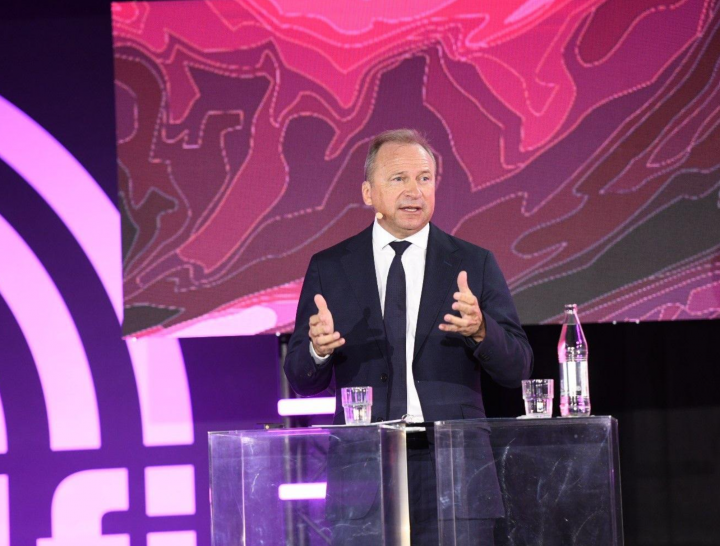
The elephant in the room, centralized supervision, was impossible to avoid during the Association of the Luxembourg Fund Industry’s annual Global Asset Management Conference in Kirchberg on Tuesday. Though in favor of supervisory convergence, Luxembourg remains firmly against centralized supervision by Esma, the European securities and markets authority.
The EU’s Market Integration and Supervision Package (MISP) is a package of measures designed to remove barriers and create a more integrated, efficient, and competitive financial system in the EU. Adopted by the European Commission in December 2025, the MISP proposes the broad transfer of supervisory powers to the Esma, an idea that is raising concerns in Luxembourg. Member state representatives are due to discuss the package next week in Brussels. The warning signals from Luxembourg are clearly intended to be interpreted in that context.
Policy proposals are meant to provide a solution to an issue. But “to some extent, from the CSSF perspective, we fail to understand the problem that we are trying to solve here,” said Laurent van Burik, head of the enforcement, regulation and international investment fund unit at Luxembourg’s financial supervisor CSSF, speaking during the first day of the Alfi Global Asset Management conference.
‘Additional layers of complexity’
“First of all, we haven’t seen any failures in the Ucits space over the last, probably, decade which would actually justify introducing additional layers of complexity to the framework,” said Van Burik. Ucits are well-understood and well-accepted both in Europe and around the world, and the Grand Duchy has built a strong “brand” around the product. As of 31 January 2026, the net assets of Luxembourg UCIs came to a total of 6.29 trillion euro; roughly 10 percent of assets are held outside of Europe.
Esma, he continued, already has a toolkit that works. “Instead of trying to revamp the supervisory framework totally, I think we would be better off in effectively using the framework we have, and perhaps improving the tools and the way they are used,” said Van Burik. “From our perspective, the solution is not to add additional complexity or overlaps” between national competent authorities and Esma.
The CSSF, he noted, aims to ensure adequate investor protection, and “we’re not sure that what is on the table is actually needed to keep the right level of investor protection.”
Convergence, not centralization
While there are positive points in the proposal, like breaking down barriers around cross-border distribution of funds, Luxembourg has serious concerns around the harmful effect the MISP could have on Europe’s competitiveness.
The Grand Duchy’s fund industry association is strongly against the idea of giving more centralized supervisory powers to Esma, said Alfi chairperson Jean-Marc Goy, adding that he had received “unanimous feedback” from the industry, other countries, and other industry associations to the same effect. “The official narrative of the European Commission is to say: ‘We have one single market, and therefore we also need one single supervisory authority—Esma. This will simplify things and make things easier.’”
“The new proposal… would make things more complicated, more burdensome, and also, at the end of the day, more costly.”
Jean-Marc Goy, Alfi
“Regrettably, that is just not true. It is actually the opposite, because today, with the Ucits framework and in the framework of the Alternative Investment Fund Managers Directive, we have a very important, crucially important principle for the success of these products, and that is: today, we have one single supervisory authority. It’s the home country regulator that is the single supervisory authority,” said Goy. “The new proposal would not make things easier. It would make things more complicated, more burdensome, and also, at the end of the day, more costly.” And increased costs, he added, would not make Europe more attractive. On the contrary, it would have a negative impact on its competitiveness.
“Let me be clear,” added Goy, “Luxembourg is not against convergence. It is not against harmonization. We are absolutely in favor of convergence and harmonization. Our point is: Esma already has all the tools to ensure convergence and harmonization.” It can, for instance, issue guidelines and Q&A documents, carry out common supervisory actions and common enforcement actions, give opinions, and even has the “nuclear” option of the breach-of-union-law procedure.
Minister Roth: no need to reinvent the wheel
Luxembourg’s finance minister Gilles Roth hammered home the same message at the Alfi conference: Europe, he argued, doesn’t need additional complexity and administrative burden. It doesn’t need to reinvent the wheel. To meet its goals in terms of competitiveness, resilience, defence, innovation, and industrial renewal, it needs capital, it needs it now, and it needs fewer barriers to deploying that capital across borders.
That’s why Luxembourg is “cautious” around parts of the MISP, said Roth. “Let me put it plainly: centralized supervision at the EU level will not unlock the capital Europe needs. What it is doing is adding another level of complexity at exactly the wrong moment. We support strong supervision. We support convergence. We support high standards.”
Europe, he argued, needs to be “more practical.” “On the Market Integration and Supervision Package, our approach is clear: ambitious on outcomes, pragmatic on means—a very Luxembourgish approach,” said the finance minister. “We fully support removing all cross-border barriers; we oppose any indirect form of centralized supervision by Esma, including annual reviews of large asset managers. We will keep fighting for efficiencies, convergence, simplicity, and legal uncertainty. On this, Luxembourg is closely aligned with most member states, as confirmed by the last Ecofin.”
New tool for informing the CSSF about LMTs
The CSSF also aims to simplify what can be simplified to make things easier for the market. Its e-ID tools have been well-received and accepted by the market, said Van Burik. Under the revamped AIFMD II/Ucits VI, as from 16 April, fund managers will need to select at least two liquidity management tools and notify the CSSF of their selection. In the case of the activation of these LMTs, the CSSF will also need to be notified, said van Burik, and the CSSF’s new tool will smooth out this process and make it more efficient. “This will probably be helpful for the market under this new requirement.”
The revision of circular 18/698 on the authorisation and organisation of investment fund managers has been delayed, he said. “I think we need to now wait and see what will happen with the MISP before we revise our circular,” said Van Burik. “The idea is to provide certainty in terms of the regulatory framework; we don’t want to change the circular every year.”
Areas of focus for the asset management industry, he added, include liquidity risk management, valuation, ESG disclosures, cyber risk, Dora, and digital resilience, leverage, and governance, concluding that the CSSF will likely publish more on the topic at the end of the month or the beginning of next month.