
By: CIO Office, AXA IM
Central bank digital currencies may soon become a reality. With the COVID-19 pandemic definitively clearing the way for electronic payments, plans for the creation of Central Bank Digital Currency (CBDC) are multiplying. This is profoundly different from bitcoin-style cryptocurrencies. A CBDC is issued by a central bank, backed by its credibility and the law itself, like the banknotes we use every day. Cryptocurrencies however are instruments that do not belong to anyone, have no real assets backing them, and lack a clear governance structure.
The interest of central banks in digital currencies is not purely academic. In China, tests have already been carried out on retail customers, with excellent results 1. The European Central Bank (ECB) is very focused on the matter, to the point of not only producing studies and publications, but also commissioning surveys to assess the appreciation of a ‘digital euro’ among citizens and businesses. Even the Bank for International Settlements (the institution promoting coordination between central banks) has taken to the field to try to harmonise various projects.
Potential advantages – and the hurdles to overcome
But why this sudden rush for a digital currency? This is partly due to the threat of the advent of a private ‘stablecoin’, a cryptocurrency which pegs its value to an external reference point, such as Facebook’s diem (previously known as the libra) and, in general, the interest of central banks in maintaining control of the financial sector and the payment system.
The ECB has stressed that the advantages of a digital euro would be significant – from the complementarity with banknotes to the efficiency of payments, from the contribution to the digitalisation of the economy to the fight against undeclared cash. Not to mention the security of having an instrument controlled by the central bank, and not for example by private individuals residing outside the Eurozone. The ECB could also give citizens the opportunity to directly deposit their digital euros with the central bank, without the intermediation of normal credit institutions. This would be a real revolution.
However, there are more than a few kinks that need to be ironed out. If it were to open up the possibility of depositing directly with the ECB, private banks could find themselves in difficulty on the funding front. In Italy, for example, credit institutions are not transferring negative rates to their customers because they raise funds to be used through deposits - but what would happen if Italians decided to put their savings directly into ECB accounts, considered more reliable? Banks could find themselves with much less cash in their coffers.
Let’s not even talk about what would happen in a situation of panic, when the fear of private banks defaulting might force savers to suddenly transfer their money to the central bank, causing credit institutions to lose their deposit base. An ECB equipped with digital currency and open to private accounts could potentially force traditional banks to become more oriented towards investment banking and less towards the current ‘one-stop’ banking business model.
China in pole position among major economies
The Bahamas launched a national digital currency in late 2020 – the first of its kind in the world. The ‘sand dollar’ is a digital version of the Bahamian dollar aimed partly at addressing limits to traditional infrastructure across the hundreds of islands that make up its archipelago 2.
Among the major economies meanwhile, Beijing is leading the race. While the US Federal Reserve is still studying the potential, the People’s Bank of China (PBoC) will likely be the first big name to launch its own digital currency. After all, e-money is already a reality in China, with WeChatPay and Alipay (financial arms of WeChat and Alibaba) transactions that have exceeded the global transactions of Visa and Mastercard combined 3. Moreover, the Chinese banking landscape includes both private and public banks, such that there is already a higher level of continuity between the PBoC and credit institutions.
The advantage of being the first to introduce a digital currency would be tremendous - a ‘first mover advantage’ that would potentially allow China to establish the renminbi as an alternative reserve currency to the US dollar.
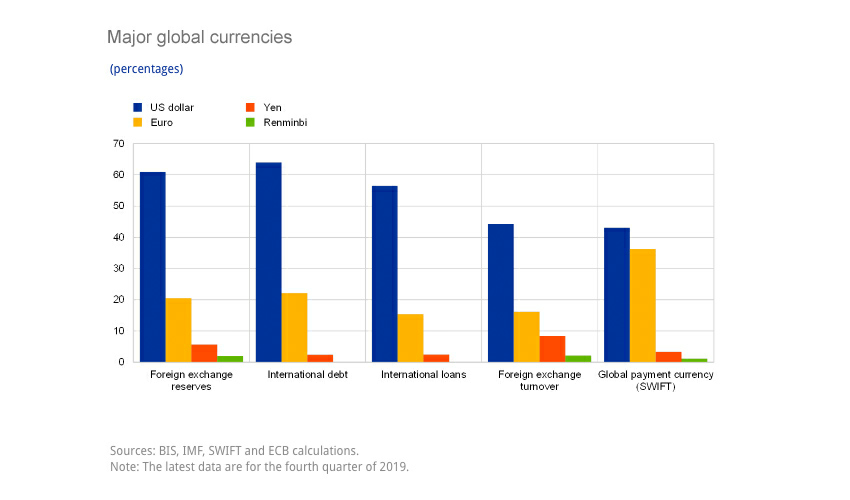
In fact, Beijing accounts for about 20% of the world economy today, but the yuan is worth only 2.1% as a reserve currency, compared to the dollar at 63% (see chart below) - the digitisation of the currency could lead to a ‘yuanisation’ of international trade. It could represent a potent currency weapon against the greenback, in particular in the Asian free trade area just consolidated with the Regional Comprehensive Economic Partnership – a colossal trade agreement that in addition to China and the 10 Association of South East Asian Nations member states also includes Japan, South Korea, Australia and New Zealand.
The experimental tests conducted by Beijing in recent months have been positive, but there are probably some problems that need to be resolved on the technological side - managing a CBDC with an audience of over one billion citizens and businesses isn’t easy. But the Dragon appears determined to cross the finish line first, conquering new territory in the world currency system.
1 https://www.coindesk.com/china-central-bank-official-reveals-results-of…
2 Central Bank Digital Currency: The First Nationwide CBDC In The World Has Been Launched By The Bahamas (forbes.com)
3 China Tech Giants’ Costly Wars to Go Cashless - WSJ
Disclaimer
Not for Retail distribution: This promotional document is intended exclusively for Professional, Institutional, Qualified or Wholesale Clients / Investors only, as defined by applicable local laws and the MiFID Directive (2014/65/EU). Circulation must be restricted accordingly.
This document is for informational purposes only and does not constitute investment research or financial analysis relating to transactions in financial instruments as per MiFID Directive (2014/65/EU), nor does it constitute on the part of AXA Investment Managers or its affiliated companies an offer to buy or sell any investments, products or services, and should not be considered as solicitation or investment, legal or tax advice, a recommendation for an investment strategy or a personalized recommendation to buy or sell securities.
It has been established on the basis of data, projections, forecasts, anticipations and hypothesis which are subjective. Its analysis and conclusions are the expression of an opinion, based on available data at a specific date. All information in this document is established on data made public by official providers of economic and market statistics. AXA Investment Managers disclaims any and all liability relating to a decision based on or for reliance on this document. All exhibits included in this document, unless stated otherwise, are as of the publication date of this document. Furthermore, due to the subjective nature of these opinions and analysis, these data, projections, forecasts, anticipations, hypothesis, etc. are not necessary used or followed by AXA IM’s portfolio management teams or its affiliates, who may act based on their own opinions. Whilst every care is taken, no representation or warranty (including liability towards third parties), express or implied, is made as to the accuracy, reliability or completeness of the information contained herein. Reliance upon information in this material is at the sole discretion of the recipient. This material does not contain sufficient information to support an investment decision. Any reproduction of this information, in whole or in part is, unless otherwise authorised by AXA IM, prohibited.
Before making an investment, investors should read the relevant Prospectus and the Key Investor Information Document (KIID) / scheme documents, which provide full product details including investment charges and risks. The information contained herein is not a substitute for those documents or for professional external advice. Those documents are available free of charge from AXA IM Benelux SA/NV, Place du Trône 1 – 1000 Brussels, and on the website www.axa-im.be.
Past performance is not a guide to current or future performance, and any performance or return data displayed does not take into account commissions and costs incurred when issuing or redeeming units. References to league tables and awards are not an indicator of future performance or places in league tables or awards and should not be construed as an endorsement of any AXA IM company or their products or services. Please refer to the websites of the sponsors/issuers for information regarding the criteria on which the awards/ratings are based. The value of investments, and the income from them, can fall as well as rise and investors may not get back the amount originally invested. Exchange-rate fluctuations may also affect the value of their investment. Due to this and the initial charge that is usually made, an investment is not usually suitable as a short term holding.
This document has been edited by AXA IM Benelux S.A., a company incorporated under the laws of Belgium, having its registered office located at Place du Trône, 1, B-1000 Brussels, registered with the Brussels Trade and Companies Register under number 604.173.
© AXA Investment Managers 2021. All rights reserved.