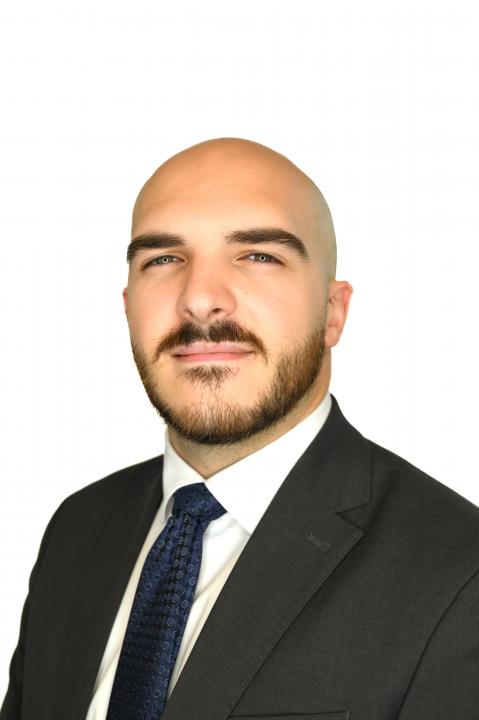
After studying politics, Jean-Paul Daragjati set his sights on finance through a hands-on master’s in wealth management at the University of Luxembourg. Now a private banker at Edmond de Rothschild, he says the secret to success is to never stop learning.
Twenty-seven-year-old Jean-Paul Daragjati carries an air of calm confidence and looks older than his years, which he jokes is due to his baldness. “You can call me JP,” he told the Investment Officer interviewer. “Jean-Paul is really old-school!”
Though Daragjati grew up in Luxembourg, where he was exposed to the world of finance and economics from a young age, “I didn’t start out with an interest in private banking,” he said. “I wanted to go into politics.” He went on to study in Munich, where he obtained a bachelor’s degree in political science and law, international relations and political economy.
During his studies, he did an internship at the Chamber of Deputies in Luxembourg, a “huge honor.” “I learned a lot and I appreciated the time that I spent there,” Daragjati said, “but I figured out that it wasn’t exactly what I wanted to do.” It was the financial side—especially banks and investment structures—that captured his attention. When he discovered the Master in Wealth Management at the University of Luxembourg, his trajectory shifted.
A hands-on master’s program
First launched in 2013, the wealth management master’s program was extended into a more in-depth two-year format in 2019. Developed together with the Grand Duchy’s financial center and the ABBL’s private banking working group, it combines traditional finance topics with subjects like client relationship management and estate planning.
Daragjati describes it as a “professional” master’s with practical knowledge shared by financial industry experts from inside and outside Luxembourg. “It allowed us to discover not just the academic side, but also what the business and the job look like outside the books: how do you discuss with clients? What kind of structures come up in business in Luxembourg, in Europe, worldwide? How do investment funds work? How do structured products work?”
Daragjati’s cohort was composed of roughly 35 students, ranging in age from early 20s to professionals in their 40s. Six or seven participants were Luxembourgish, a higher number than usual, joining a highly diverse group: “We had people from China, France, Italy, Bangladesh, India,” said Daragjati. “It was extremely multicultural.”
What he appreciated most was “the fact that professors took time outside of the curriculum to meet with us, to discuss, to explain our strengths, where they saw potential, what weaknesses students had,” he said. In terms of quality, it was “a very nice master’s that prepared me for quite a few things in my professional life.”
Looking beyond “son-of” or “daughter-of”
Daragjati spent six months as an investment advisory trainee at Banque Internationale à Luxembourg and joined Edmond de Rothschild as a private banker in October 2024. Though he is calm and confident today, this wasn’t always the case. “I want to be transparent,” he said. “At the beginning, the thought of being in front of clients or prospects that were looking to do investments in the realm of multiple millions intimidated me. Fortunately, there were a lot of people who supported me, who were ready to mentor me, which allowed me to develop a strong sense of self-confidence quite early on.”
Daragjati also finds it easier to connect with younger clients because he’s adept at seeing them as individuals. “They understand that in front of them, it’s not someone who just sees them as a son or daughter of a client. With me, they have someone who actually sees them for who they are, with their own projects, their own ambitions,” he said.
Be a Swiss army knife
Being a private banker involves a lot of responsibility and getting up to speed with regulation. “I knew for the first six months, it would be: ‘JP, you have to learn, learn, learn, as much as you can.’” But it’s not something that stops after the first six months. Daragjati uses AI tools—including an internal system—to boost his knowledge and evaluate what he’s learned by testing himself with hypothetical cases. It’s key, however, not to “shut off your brain,” and Daragjati emphasized that he follows up with his own research. Every situation is different, and it is humans who give advice and provide the added value.
Beyond learning about financial regulation, Daragjati has some key pieces of advice for prospective students. First, be open to learning new languages. Though already fluent in English, French, German, and Luxembourgish, the young private banker is also picking up Italian and Spanish. Second, being an “approacher” who meets new people and starts a conversation, even if it’s not directly related to business, allows you to learn about yourself and others.
Finally, keep building up your knowledge. The more you know, the more information you’ll be able to provide to prospects and clients. This, Daragjati noted, is not just applicable to private banking, but also extends to law, fiduciary activities, and beyond. “You want to be a Swiss Army knife. You don’t have to be a seasoned expert in everything, but try to know as much as you can about as many topics as possible.”