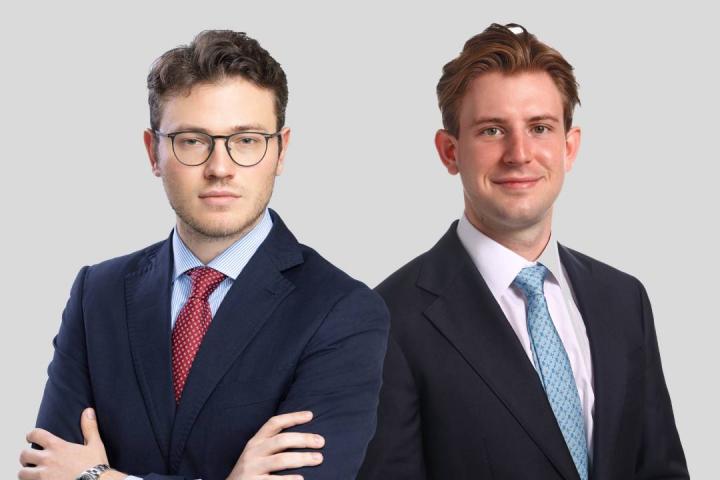
Luxembourg is full of opportunities to explore the world of private banking and make your mark, explain two young bankers at Citi. Despite the country’s dreary climate, they highlight the Grand Duchy as an appealing place for young people starting out in the industry.
While 26-year-old Michael Lasala has always been drawn to numbers, it was a high school reading assignment that sparked his interest in finance. “My conclusion was that to initiate evolution, you need to allocate resources in the right manner,” he said. The world of finance provides this opportunity, and he wanted to be part of it.
Lasala went on to obtain a bachelor’s degree in economics and finance from Università Bocconi in Italy and a master’s degree in finance from the ESSEC Business School in France, then debated between a career in asset management or private banking. “I love to be with people, to interact with people,” he said, which made private banking a “natural fit.” He joined Citi Private Bank in Luxembourg as an analyst in June 2024.
Also 26 years old, Ludwig Graf grew up near Frankfurt. He received his bachelor’s degree from the Accadis Hochschule Bad Homburg and a master’s degree in finance from the University of St Andrews in Scotland, where, he noted, the weather was not terribly different from that of Luxembourg. “I wanted to go into finance before I started my master’s, but this was the final push,” he said. He joined Citi in Luxembourg in July 2025.
Why private banking in particular? “It’s the mix between the relationship side and the technical side,” explained Graf. He enjoys the “hybrid” nature of his work, which combines analytical aspects and the opportunity to talk to people, something that suits his extroverted personality.
Wide spectrum of wealth management
While neither banker plans to return to academia for further education – Graf decided against pursuing a PhD, while Lasala passed the CFA Level 1 in 2023 – both point to internal Citi training programs and exposure to senior private bankers as valuable ways to learn on the job.
Citi’s graduate program allows young private bankers to experience a variety of functions. “It could be related to the specific rotation we’re in right now, but if someone else comes in and needs our help, of course we help,” said Graf. The day-to-day work is also wide-ranging. “You get to work with one client on fixed income; with the next client, it’s equity. You do a presentation, or you help with planning an event,” he explained. “It shows us the whole breadth of the wealth management spectrum.”
Lasala held several finance-related roles before joining Citi, including positions at an asset management firm and a private equity firm. His current role is varied: “You do a lot of investment proposals, market monitoring, portfolio reviews. At the same time, you also have the creation of products. So you’re broadly exposed to a lot of tasks.”
Later on, bankers who wish to follow the “product route” will need to specialize in a certain area. Those who stay in the “investment counselor” role will remain more “all-arounders.” Lasala, whose cohort is one year ahead of Graf’s, plans to continue with investment counseling for now but sees himself moving into a “pure banker role” in 10 to 15 years. “It’s more about the people, it’s more about the relationships, and not just the investment side.”
Graf envisions himself more on the “front office end” of wealth management, but hasn’t completed his other rotations yet and is keeping his options open. Despite starting in Citi’s program just five months ago, he noted the amount of regulation that impacts the private banking sector, something often heard from more experienced figures in the industry. “I knew about MIFID and that all these financial regulations existed, but I didn’t know how difficult it sometimes is in this landscape,” he said.
Like tailoring a suit
Though both hold junior roles at the bank, Graf and Lasala are already engaging with clients, and do so confidently, thanks to careful preparation.
“I try to be extremely prepared, to think in advance what might be asked,” said Lasala. He emphasized the importance of reviewing previous interactions and getting a “holistic overview” of a client, adding that it’s “extremely important to listen.” “I’ve realized that this is a business based on understanding people,” he said. He compares investment counseling to creating bespoke clothing: “It’s like going to a tailor and asking for a suit. You might think it’s just a broad offering of several financial products, but every client has specific needs.”
Like his colleague, Graf doesn’t feel overwhelmed or stressed, but makes sure that he’s well prepared before every client meeting and adapts to the situation. “I know what I’m going to talk about, I know every question that might be asked, but then I go with the flow,” he said. “It doesn’t really matter if it’s with an older person or a younger client, as long as you know your stuff and you’re well prepared, they take you seriously.”
Human touch to remain at core of work
While both young private bankers use AI as a tool to support them in their work, they emphasize that it’s essential to double check information it provides. AI tools will become “way more powerful,” said Lasala, but humans will continue to provide “critical thinking” and “additional value” for clients.
Citi has its own in-house large language model, Graf pointed out, which is useful for summarizing or quickly retrieving information. However, it’s key not to over-rely on such tools. “In the longer term, I’m not extremely concerned about what’s going to happen,” he said, looking ahead as to how his career in the private banking industry might evolve. “This role is about people. And I trust the fact that the interactions with people will remain.”
Luxembourg: an attractive country
Both Graf and Lasala moved to Luxembourg to join Citi – Graf came to the Grand Duchy after finishing his master’s in Scotland, while Lasala came from a firm in Zurich – and both describe Luxembourg as an attractive country for young professionals thanks to its multicultural environment, safety, digitalized procedures, and growth prospects.
Jokes about the weather aside, “this place is growing every day,” said Lasala. “It’s where the opportunity is.”