
The signals that citizens and businesses are willing to leave their country if the tax burden becomes high enough are increasing rapidly. As a result, an economic theory that is already fifty years old—and long dismissed as meaningless fantasy—is suddenly taking center stage.
In the fall of 1974, four men gathered in a restaurant in Washington to express their dissatisfaction with the planned tax increases by then-president Gerald Ford. Donald Rumsfeld, who at the time was Ford’s chief of staff before becoming secretary of defense; Dick Cheney, who would later succeed Rumsfeld as the youngest chief of staff ever; Jude Wanniski, journalist at The Wall Street Journal; and Arthur Laffer, then an associate professor of economics at the University of Chicago, later a full professor.
During their conversation, Laffer argued that a tax increase would not necessarily lead to higher tax revenues. Lower rates, on the other hand, would stimulate economic growth and would generate higher tax revenues. To illustrate his argument, Laffer drew on a napkin what we now call the Laffer curve.
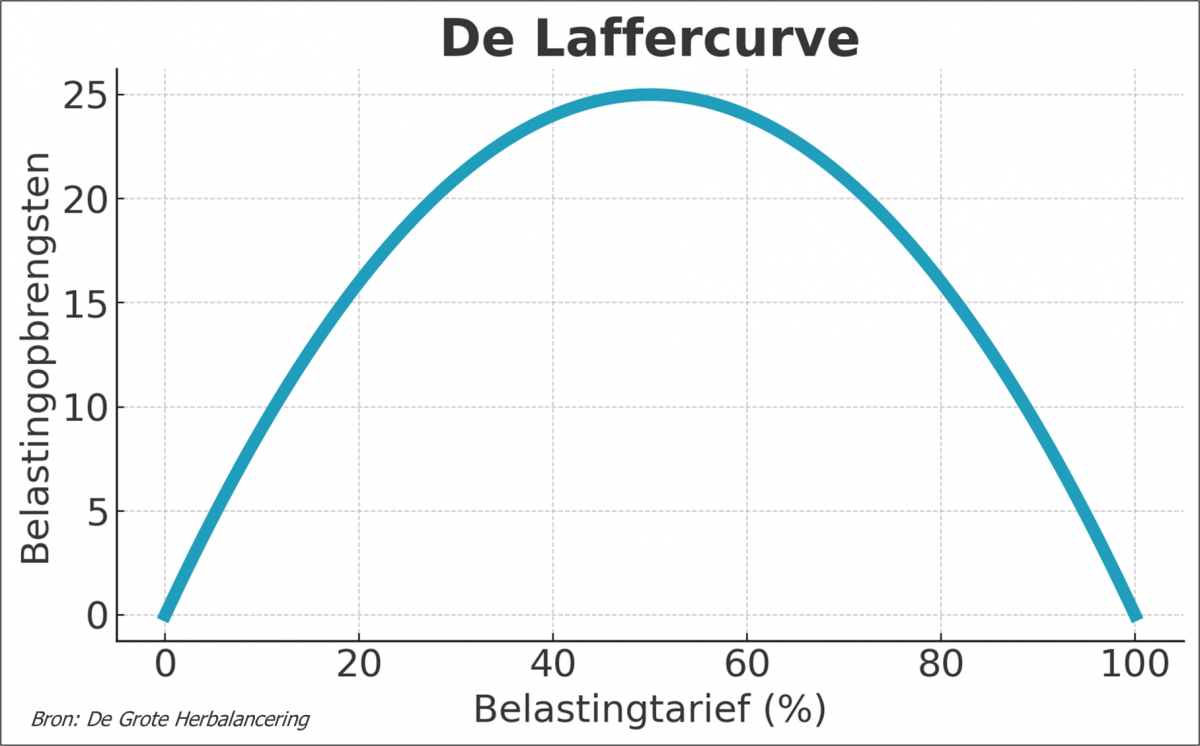
The two paragraphs above are from my book The Great Rebalancing, which underlines that I do take the concept of the Laffer curve very seriously. When governments cross a certain threshold in taxing income, profit, or wealth, it becomes counterproductive. People and businesses gain an incentive to evade taxes, leave a country, or simply stop working.
Headlines
The Laffer curve recently made headlines at Bloomberg, which argued that proposed plans by several US states to tax wealth more heavily could easily result in lower tax revenues. Not least because wealth is easier and faster to move than income, which is often tied to a job in a particular state.
Lies
In a recent working paper by the Hoover Institution, analysts calculate that the proposed Billionaire Tax Act in California, which includes a one-time tax of 5 percent on the global wealth of individuals with more than 1 billion dollar, will not deliver what is being claimed. Supporters of the tax have suggested that it would generate at least 100 billion dollar in additional tax revenue. The Hoover Institution researchers, using actual calculations, arrive at a very different conclusion. Instead of an additional 100 billion, they estimate a loss—converted to today’s terms—of nearly 25 billion.
The reason is simple and aligns exactly with the theory of the Laffer curve. Even before the proposal has been put to a vote, 30 percent of those subject to the tax have already left California. Because these ultra-wealthy individuals generally also have very high incomes, the loss of future income tax revenues results overall in a negative, rather than positive, effect.
Flat learning curve
The civil servants in California who put forward this populist proposal are characterized by a lack of knowledge and insight. Insight into their own citizens, no less.
In 2022, a few policymakers in the Norwegian government believed that increasing taxes on the wealth of rich Norwegians would significantly boost the state treasury. Those taxpayers saw things very differently. They moved en masse, taking more than 50 billion dollar in wealth to Switzerland, with the end result that the Norwegian treasury lost as much as 450 million dollar.
But it can get even more bizarre. Barely a year earlier, in 2021, taxable wealth in the Norwegian municipality of Bø increased by 60 percent when the wealth tax was actually reduced.
Off track
There are, of course, many people who argue that the wealthy should be taxed more heavily anyway. That is somewhat more nuanced, but the debate is entirely irrelevant if the outcome is lower tax revenues. In fact, if you assume that a significant portion of taxes ends up—or should end up—with the less well-off in our society, then as a policymaker you are completely missing the mark. Politicians are increasingly losing touch with reality.
What policymakers also seem not to understand is that the Laffer effect has much broader consequences than just the departure of wealth. Those who leave also take their human capital with them, as well as that of their children and other family members. In addition, excessively high taxes discourage people from pursuing education, gaining experience, and simply working. A massive destruction of human capital.
Conclusion
Finally, please do not confuse this column on the Laffer curve with the idea that investing will no longer make sense. The exact opposite is true. The rules are flawed, the rates far too high, but investing is still a thousand times better than saving.
Jeroen Blokland analyzes striking, up-to-date charts on financial markets and macroeconomics. He is also manager of the Blokland Smart Multi-Asset Fund, a fund that invests in equities, gold, and bitcoin.