
AI is not a bubble by definition. But the investment wave surrounding it is. The first hairline cracks are now clearly visible, and comparisons with the run-up to the global financial crisis are becoming hard to dismiss.
The largest technology companies are investing hundreds of billions of dollar in AI infrastructure, such as data centers, semiconductors, networks, and energy. Strikingly, those same large technology companies borrowed about 160 billion dollar, despite their strong cash flows and massive bank balances. At the very least, that deserved an orange flag.
Blue owls do not exist
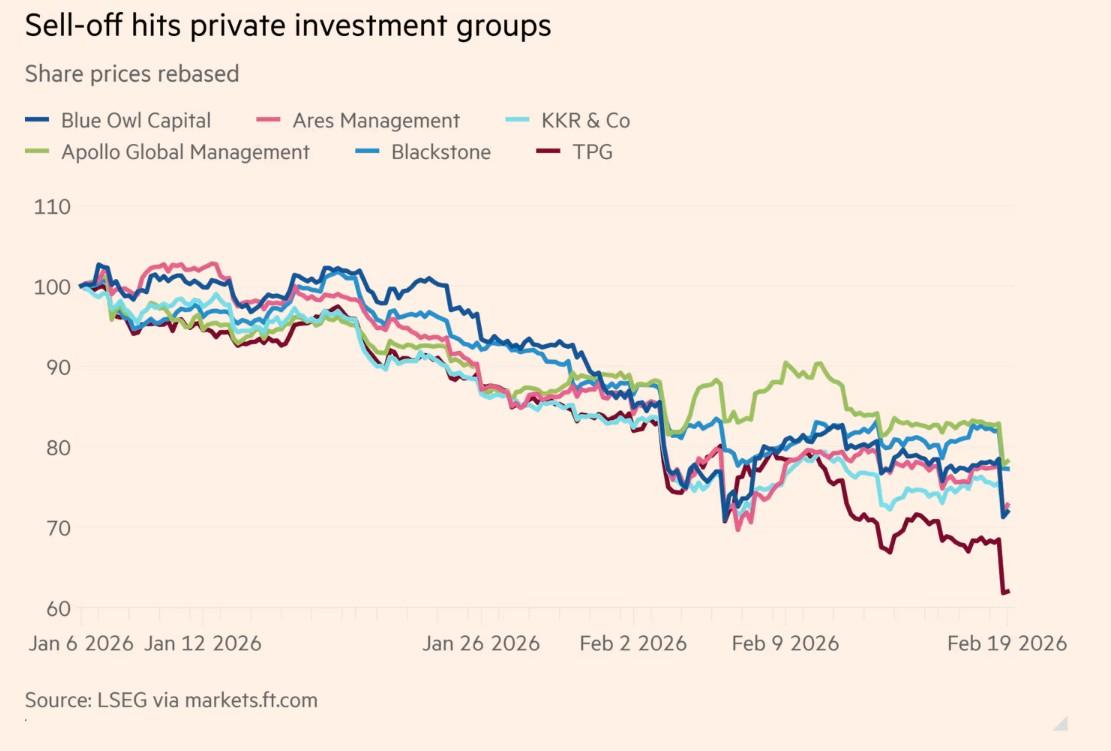
Among the lenders is Blue Owl, a major provider of private loans to, among others, software companies. Those companies are under enormous pressure because investors, rightly or wrongly, have concluded that software profits are in trouble with the rise of AI.
This dynamic means that investors, who have often stuffed themselves with private loans, now suddenly want their money back. Think, for example, of US insurers that have 35 percent (that is not a typo) of their assets invested in private credit. That amounts to roughly 2,000 billion dollar.
To prevent a genuine fire sale, Blue Owl has permanently (apparently that is possible) closed one of its funds to redemptions.
Déjà vu
If that last point triggers a sense of déjà vu, that is hardly surprising. Do you remember the three BNP funds that had to shut down in 2007 due to so-called “liquidity problems”? Later followed by the closure of two Bear Stearns hedge funds holding subprime mortgages? What a fantastic term that remains: subprime mortgages.
Debt light
Blue Owl also provided a large loan to Meta, which rakes in billions in profit every quarter. The reason is easy to guess. Extremely low interest rates and very flexible terms. With that combination, any healthy company will eventually come knocking. That endless inflow of new money has to be “put to work,” after all.
Even now, there are countless naive (what I really want to say is stupid) investors who fall for the beautiful marketing stories. A basket of “junk loans,” after all, is supposedly very creditworthy.
The canary
Blue Owl is merely a canary. It will not go bankrupt because of Meta. The vulnerability lies with all those small companies that do not have superior cash flows and that are also forced to invest heavily in AI. They will be the first to face downwardly revised growth expectations.
As “The Dean of Valuation,” Aswath Damodaran, argued in a recent piece, the dynamics become far uglier when debt is involved. As long as AI investments are primarily financed with equity, the pain falls on shareholders when expectations are revised downward.
The domino
But when those investments are fueled by debt, a chain of closely connected lenders comes under pressure. Private credit firms will eventually have to revalue their loans, and that is when the floodgates open. Only then will it become clear where the credit risks reside and how the interconnections are structured. An interesting aspect of this credit bubble is that the problem is not confined to banks. Investors in private loans are everywhere.
Quality is king
In recent years, investors have consistently focused on the exorbitant debt burden of governments. And believe me, that is entirely justified. In the coming years, another debt dimension will be added: that of companies. The big difference with governments, however, is that companies do not have access to a gigantic money printer. When the music stops, it is truly over for companies.
It therefore seems logical to me that companies that are not forced to invest excessively to satisfy their stakeholders’ AI ambitions will outperform the market. Scarce quality companies, characterized by relatively low capital intensity, limited capex requirements, and free cash flows, have a fundamental advantage. One that, moreover, has been scientifically proven (Fama and French) to be associated with outperformance.
Apparently, US insurers see things just a little differently.
Jeroen Blokland analyzes striking and timely charts on the financial markets and macroeconomy. In addition, he manages the Blokland Smart Multi-Asset Fund, a fund that invests in equities, gold, and bitcoin.