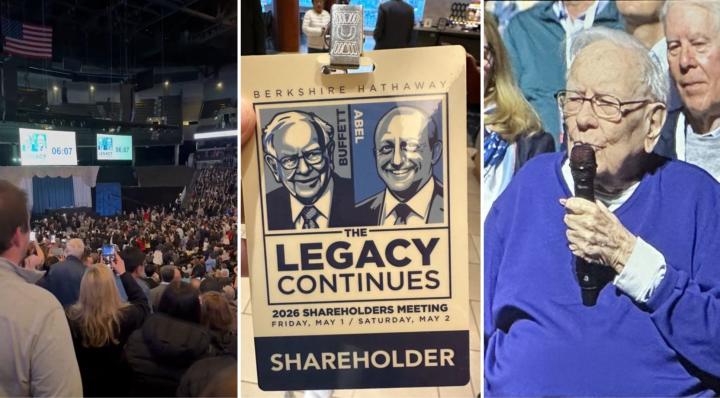
A group of Belgian investors returned to Omaha this weekend for Berkshire Hathaway’s annual meeting, but for the first time Warren Buffett was not on stage. The 95-year-old still attended, yet the tone of the “Woodstock of capitalism” has begun to shift.
Around 25,000 investors made the trip, down from 40,000 a year earlier. The festival atmosphere remained intact, but attention increasingly turned to Greg Abel, the designated successor who is already reshaping the message.
Pieter Slegers, founder of Compounding Quality, said the meeting offered a different kind of insight.
“We learned more about Berkshire’s business this year than in the past ten annual meetings combined,” he told Investment Officer. “There were fewer broad lessons about markets and life, and much more focus on the company’s operations.”
Float question
For Slegers, the central issue is whether Berkshire can still outperform.
“The key is the float — roughly 177 billion dollars generated by the insurance operations,” he said. “In a hypothetical scenario, if Berkshire simply replicated the S&P 500 using that float, the holding company would already outperform the index.”
He also pointed to Berkshire’s relative performance since Abel was named chief executive.
“Since that announcement, Berkshire has underperformed the index by about 40 percent over a one-year period. The last time we saw that was in 1999,” Slegers said. “For long-term investors, it may make sense to view Berkshire as a kind of index. It trades at a lower valuation, offers broader diversification, and holds significant cash to deploy in a downturn.”
The long-term record remains difficult to ignore.
“If you had invested 10,000 euros in Berkshire in 1965, that would be worth about 3.6 billion dollars today, compared with roughly 6 million dollars for the S&P 500,” he said. “Even if you removed 99 percent of Berkshire’s return, you would still have beaten the index.”
Operational shift
Jurgen Vluijmans, managing director at Backstage Communication, noted both the smaller crowd and the change in tone.
“There were fewer visitors, which you could already see in the restaurants on Friday evening,” he told Investment Officer. “But the American-style festival atmosphere was still very much there.”
On stage, however, the shift was clear.
“With Greg Abel, the style is far more businesslike,” he said. “He focused on operational efficiency and even compared Berkshire’s railroad business with its five main competitors. That is something we have not seen before.”
Abel also set out a more disciplined approach to new technologies.
“He made it clear they will not adopt AI just because it is fashionable,” Vluijmans said. “They plan to apply an AI-driven efficiency model to the railroad business first, and then use that as a template for other operations. Improving efficiency was a very clear message.”
Legacy and transition
Kristof Heyndrikx, founder of Potential Multibaggers, said the event still carries a unique status among investors.
“If you have never been here, it is hard to understand how accurate the comparison with Woodstock is,” he told Investment Officer. “There are dozens of side events with leading investors alongside the main stage.”
Buffett’s presence continues to define the gathering, even off stage.
“For shareholders, he remains a mythical figure,” Heyndrikx said. “At 95, he still holds the audience’s attention completely.”
Abel, he added, brings a different profile.
“He may be the chief executive Berkshire needs now,” Heyndrikx said. “He has deep operational experience. If you want the trains to run on time, that may matter more than Buffett’s hands-off approach.”
Buffett’s influence, however, has not disappeared.
“Buffett still comes into the office every day,” Heyndrikx said. “They continue to discuss investments, so he remains closely involved.”
Discipline over action
Michael Gielkens, founder of Tresor Capital, highlighted the symbolic language used during the meeting.
“Abel consistently referred to an ‘owners’ meeting’ rather than a ‘shareholders’ meeting’,” he told Investment Officer. “The theme was ‘the legacy continues’, which reflects the transition now under way.”
Buffett, speaking from the audience, pointed to Berkshire’s long-term discipline.
“He said the company invested just over 35 billion dollars in Apple, and that the position has grown to more than 185 billion dollars including realized gains and dividends,” Gielkens said. “In his words, Berkshire ‘did not have to do anything’ to achieve that.”
That message was reinforced by both Abel and insurance head Ajit Jain: in most cases, doing nothing remains the optimal strategy.
At the same time, some operating signals are turning less favorable.
“Clayton Homes, Berkshire’s housing unit, acts as an early indicator for the US economy,” Gielkens said. “Revenue declined by about 10 percent last quarter, which is not a positive sign.”
Charisma gap
Kevin Schoovaerts, who runs 100baggerhunting.com, said Buffett’s presence still dominates the room.
“When Buffett walks in, everything stops,” he told Investment Officer. “Even at 95, he commands the entire audience.”
The comparison with Apple’s leadership transition is instructive, he added.
“Steve Jobs had a similar charisma, which Tim Cook did not,” Schoovaerts said. “Yet Cook delivered exceptional results. Greg Abel may be that type of leader for Berkshire.”
The broader ecosystem around the meeting remains largely unchanged.
“The exhibition hall, where you can buy products from Berkshire’s subsidiaries, was as busy as ever,” he said. “From ice cream to jewelry, everything was selling.”
The combination of continuity and change is likely to define the event in the years ahead, even as Buffett’s role gradually recedes.