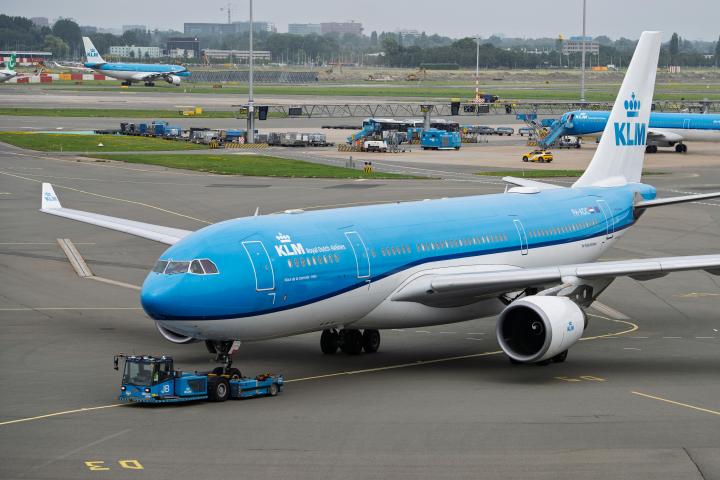
The energy crisis and looming jet fuel shortage are a disaster for aviation, but could also hit equity markets hard after all. Asset managers are gloomy about the aviation sector and warn about the consequences for investors.
Due to the blockade of the Strait of Hormuz, significantly less jet fuel is reaching the global market. In mid-April, the International Energy Agency (IEA) warned that Europe may have only around six weeks of aviation fuel remaining, and that large-scale flight cancellations could quickly follow.
Robeco has very limited investments in the aviation sector because of volatile results, low margins, relatively heavy government involvement, unfair competition, and high CO2 emissions. The asset manager therefore does not invest in Air France-KLM or other major European airlines, portfolio manager Arnout van Rijn explained.
Some US funds do hold positions in United Airlines, but total exposure is negligible, according to Van Rijn, who argues that the energy crisis and looming jet fuel shortage will have little impact on Robeco, given its minimal exposure to the sector.
Blackrock’s BGF Future of Transport fund also has no direct exposure to airlines. Charles Lilford, one of the fund’s managers, is pessimistic about the aviation sector in the short term. “Fuel shocks can have a significant impact. Fuel accounts for more than a quarter of operating costs. Even before the conflict in the Middle East, IATA expected the global aviation sector to achieve a return on invested capital of 6.9 percent in 2026, well below the cost of capital of 8.2 percent.”
At the same time, he emphasized that long-term demand remains strong, with the number of airline passengers expected to grow significantly through 2050, supporting demand for new aircraft. “However, we prefer high-quality suppliers, software, and efficiency solutions over airlines and aircraft manufacturers. The market is also increasingly focusing on the space sector, where many interesting IPOs are expected.”
Major blow
While the aviation sector has performed poorly year to date for investors, equity markets more broadly remain in positive territory. Van Rijn is surprised by the optimism. “Sooner or later, investors will realize that this energy crisis and potential jet fuel shortages could hit the economy hard. I would be cautious about increasing equity positions right now. It is tempting to take some profits on AI stocks.”
At the sector level, Van Rijn expects the consumer sector in particular to be hit by the oil shock, because higher fuel prices effectively act as an additional tax. Robeco has also become more cautious on Europe. “The economic impact of high oil and gas prices is greater here than in the United States.” Emerging markets in Asia are also being hit relatively hard. “We do not yet see this reflected in the index because AI stocks from Taiwan and South Korea are currently dominating sentiment.”
Portfolio adjustments
In March, Robeco reduced its overweight position in equities to neutral. Van Rijn: “Initially, that worked out well, but April brought a rapid market rebound. Our multi-asset funds also benefited from that and are weathering this external shock relatively well so far.”
The asset manager also recently increased its allocation to commodities from underweight to neutral, representing around 4 percent of its strategic mix. “We expect global inflation over the next five years to come in higher than anticipated. Commodities could benefit from that. We are opting for broad exposure, including positions in gold and industrial metals such as copper and aluminum. These benefit from the energy transition, which will likely accelerate because of this oil crisis.”
Van Rijn also considers gold more attractive as an inflation hedge than oil. “Over the long term, oil does not provide strong inflation protection. We do maintain some exposure because of the tail risk of further price increases, but historically, energy companies have been better long-term investments than oil itself.”
Electrification of transport
Lilford of Blackrock focuses his fund on the electrification of transport. “Tightness in fuel markets and strategic vulnerability strengthen our conviction in the parts of the sector that are easiest to electrify: rail, freight transport, and light vehicles. We are increasing our exposure to electrification and to companies within these supply chains.”
According to the fund manager, developments in Ukraine and the Middle East have increased awareness that energy supply is a matter of national security. “Resilience and independence will play an increasingly important role in government policy. Add to that the fact that AI depends on computing power, and therefore on sufficient energy, and it is clear that electrification is one of the most attractive structural investment themes today.”
Lilford also sees technology being applied more concretely within transportation. “The biggest opportunities lie in the physical application of AI, such as autonomous driving, robotaxis, robotics, and drone technology. Applications such as route optimization for fuel efficiency, manufacturing, and logistics are also promising.”
Within aviation, he expects airlines with modern fleets and companies contributing to fuel efficiency to be the relative winners. “Operators with next-generation aircraft benefit from significantly lower fuel costs. In the current environment, that represents a clear competitive advantage.”