
Former European Commission president Jean-Claude Juncker warned that Europe risks losing its remaining seats in the Group of Seven as the continent’s economic weight continues to decline in a rapidly shifting global order.
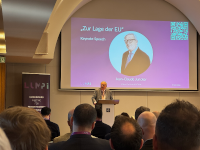 “In 15 years, there may not be a single European country left in the G7,” Juncker said at the German-language Lumpi investor conference in Luxembourg, pointing to long-term demographic and economic trends reshaping global power.
Juncker framed the warning as part of a broader argument that Europe must confront its declining relative position in the world. The continent once accounted for around 30 percent of global economic output but now represents roughly 15 to 16 percent, he said.
“Today around 80 percent of the world’s economy lies outside Europe,” he said. “That will not be without consequences.”
One-sided dependence on U.S.
“I believe we must better justify our role in the world,” Juncker told Investment Officer on the sidelines of the conference. “That means we need to conclude trade agreements so that we can reduce our one-sided dependence on the Americans.”
At present, Europe is represented in the G7 meetings of the world’s biggest economies with Germany, France, Italy and the United Kingdom. Since the 1981 summit in Canada, the European Union is regarded as the 8th member and the privileges and obligations of membership but without the right to host or chair a summit.
The former commission chief argued that Europe can only maintain influence by acting collectively rather than as fragmented national economies. Completing the EU’s capital markets union and banking union remains essential, he said, as does deeper cooperation on defence and trade.
Juncker defended the European Union’s strategy of negotiating trade agreements around the world, arguing they remain critical to economic prosperity and employment in Europe despite political resistance in some member states. The EU recently agreed a trade agreement with the Mercosur block in Latin America, a deal that was rejected by the European Parliament amid fierce resistance from French farmers.
“Trade agreements are massively unpopular,” he said. “But the opposite is true. They are about our jobs and our prosperity.”
Peace dividend ‘exhausted’
Juncker said Europe must adapt to a more unstable geopolitical environment shaped by Russia’s war in Ukraine, tensions in the Middle East and growing strategic competition between major powers.
“The peace dividend is exhausted,” he said, referring to the period of relative stability that followed the end of the Cold War.
Europe’s defence landscape remains inefficient, Juncker said, noting that European countries operate far more weapons systems than the United States and rely heavily on national procurement rather than joint European projects. Greater cooperation could save substantial sums that could be used elsewhere, he added.