
Hard-currency emerging-markets sovereign debt held up modestly better for European investors than for US investors in the first quarter of 2026. Euro‑based returns were broadly flat, compared with a roughly 0.2% decline for US dollar‑based investors.
Coming into the year, prudent economic policies, improving growth prospects, and largely contained inflation across much of the emerging markets universe, were supportive of the asset class. That backdrop shifted following the attacks on Iran in late February 2026. Although sovereign spreads have widened in aggregate since the conflict began, the overall magnitude has remained fairly contained thus far, masking differences across countries. Energy‑importing sovereigns such as Egypt, Sri Lanka and Kenya face fresh headwinds while exporters, particularly in the Middle East, may prove more resilient.
Within the Morningstar Global Emerging Markets Bond category, we compare two strategies carrying People and Process Pillar ratings of Above Average: BGF Emerging Markets Bond and Barings Emerging Markets Sovereign Debt.
People
Blackrock’s People Pillar rating was upgraded to Above Average in March 2026 as the team regained stability. Back in 2022 two internal units, led by Amer Bisat, were merged. Then, in 2025, Bisat left the firm to serve as Lebanon’s Minister of Finance and Trade. Long-time manager of BGF Emerging Markets Bond, Michel Aubenas, assumed leadership of the team, though he continues to devote most of his time to portfolio management. Comanager Silvio Zanardini’s formal appointment in 2024 recognized his long-standing contribution to idea generation, while experienced colleagues such as Kirill Veretinskii add further depth. The strategy benefits from one of the largest emerging‑markets debt teams with 25 specialists covering corporates, sovereigns and both local and hard‑currency markets.
In contrast, Barings’ People Pillar rating was downgraded from High to Above Average following the announced August 2025 retirement of veteran comanager Ricardo Adrogué. Lead manager Cem Karacadag, who succeeded Adrogué as head of global sovereign debt and currencies and brings three decades of experience, remains in place, while newly appointed comanager Vasiliki Everett adds meaningful expertise across trading, portfolio construction and sovereign analysis. The team remains well-staffed, with four portfolio managers, four sovereign analysts, a quantitative analyst, two dedicated emerging‑markets traders, and additional support from the firm’s nine emerging-markets corporate credit analysts. However, Adrogué’s departure leaves a significant gap that the firm does not plan to fill.
Process
Blackrock’s process blends top‑down macro positioning with bottom‑up country analysis, expressed through five to 10 themes while guided by disciplined sizing limits. Enhancements implemented since 2018—including a quant‑driven regime‑analysis model and stricter controls around stressed sovereign issuers—are now fully embedded in day‑to‑day decisions. Weekly investment meetings shape duration positioning, risk budgets and thematic exposures, while country allocations marry top-down and bottom-up views.
Barings on the other hand, follows a more benchmark‑agnostic, high‑conviction approach with relatively limited formal constraints. Analysts rely on proprietary quantitative and qualitative models covering real‑economy trends, inflation dynamics, fiscal quality, and balance‑of‑payments strength. Cross‑country comparisons and implied default‑probability assessments inform country selection. While formal risk limits are looser, the process is well defined, consistently applied, and anchored in detailed sovereign fundamental research.
Portfolio
Portfolio implementation reflects the funds’ distinct philosophies. Blackrock maintains a predominantly sovereign and quasi‑sovereign hard‑currency portfolio, typically around 90 percent of assets. Off‑benchmark exposure is capped at 30 percent in aggregate and includes local‑currency debt (typically below 5 percent), emerging‑markets corporates (5 to 10 percent), and up to 10 percent in emerging-markets currencies. Country allocations are typically kept within three percentage points of benchmark weights, unless fundamentals justify higher-conviction exceptions such as the December 2025 stakes in Argentina and Venezuela. Duration is usually kept neutral to below that of the JP Morgan EMBI Global Diversified benchmark as the team prefers to maintain some defensiveness against rate moves.
In contrast, Barings runs a concentrated portfolio, with the top‑10 country exposures typically exceeding 50 percent. The approach favors countries with improving fundamentals, which in May 2025 resulted in underweights to China and several Gulf states on the back of less attractive spreads or structural concerns, alongside overweightings in countries such as Peru, Mexico, Chile, and Indonesia – positions that remained among the team’s highest conviction ideas as of February 2026. Exposure to emerging-markets corporate debt is typically kept below 10 percent. Duration flexibility is meaningful at up to 2.5 years from the benchmark. Additionally, the team makes extensive use of credit default swaps—historically just under 20 percent — to express their views where spreads appear misaligned with actual default risk.
Performance
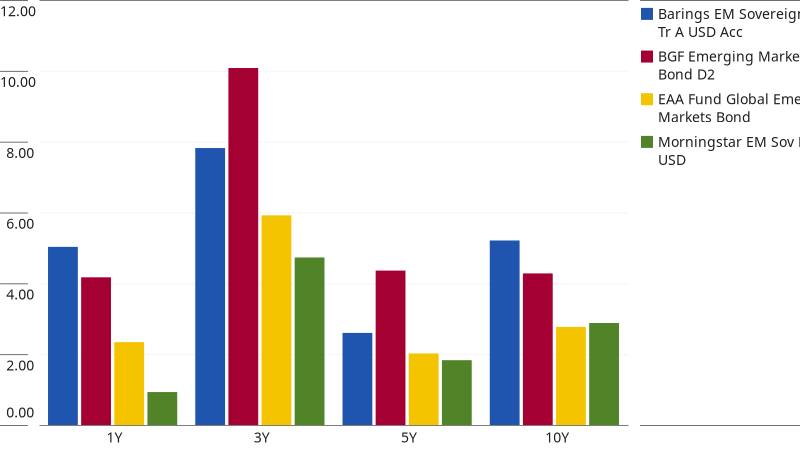
Blackrock has consistently outperformed its benchmark in recent years. After recovering from missteps in 2018, the strategy navigated the 2020 downturn well and participated strongly in the subsequent rally. It outperformed again in 2022, aided by a shorter-than-benchmark duration stance, and delivered sizeable excess returns in 2023 and 2024. Gains in those years stemmed from recoveries or spread tightening in distressed sovereigns including Venezuela, Argentina, Egypt, and Ukraine, alongside additive duration decisions. Outperformance continued in 2025 through March 2026.
Barings’ track record has been strong since its 2015 inception, surpassing both peers and the benchmark in most years except 2022. The sharp 2022 drawdown reflected overweightings in Ukraine, Russia, Belarus, and Serbia during the Russia–Ukraine conflict. Performance recovered in 2023 and beat both peers and the benchmark in 2024, supported by spread tightening in Sri Lanka, Serbia, Tajikistan, the Bahamas, and Albania. Although outperformance continued in 2025, the strategy underperformed through March 2026 with the allocation to Turkish government bonds among the detractors.
|
Fund name |
Barings EM Sovereign Debt Tr A USD Acc |
BGF Emerging Markets Bond D2 |
|
|
ISIN |
IE00BYXWSX94 |
LU0827877043 |
|
|
People Pillar Rating |
Above Average |
Above Average |
|
|
Process Pillar Rating |
Above Average |
Above Average |
|
|
Parent Pillar Rating |
Average |
Above Average |
|
|
Morningstar Medalist Rating |
Silver |
Neutral |
|
|
|
Performance Chart
Source: Morningstar Direct. Return type: Annualized return (%). Currency: Euro. |
||
Elbie Louw CFA CIPM is a senior analyst in manager research at Morningstar Benelux. Morningstar is a member of the Investment Officer expert panel.