
Investors continue to shun EUR cautious allocation funds as fixed income regained popularity.
Over the past three calendar years, funds in the EUR cautious allocation category saw more than 25 billion euro worth of outflows whereas those in the globally oriented category lost more than double that. This stands in contrast to balanced and more offensive multi-asset portfolios that witnessed inflows in 2025. Since 2022, portfolios tilted towards credit, in particular high-yield issuers, have outperformed strategies with higher duration exposure.
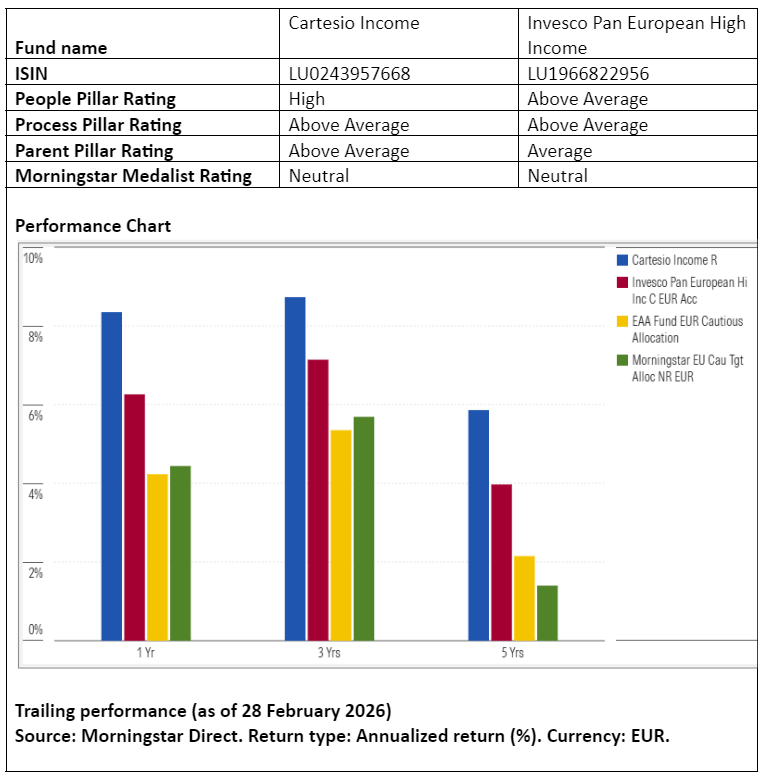
Against this backdrop, we take a closer look at two rated strategies in the EUR cautious allocation Morningstar Category that greatly benefited from their overweight to credit. While Invesco Pan European High Income became the largest fund in its category at the end of last year, Cartesio Income has been flying under the radar of investors.
People
The team at Cartesio stands out in terms of experience, stability, and alignment of interest with investors. We continue to hold the managers and firm founders Juan Bertrán, Alvaro Martinez, and Cayetano Cornet in high regard. This dedicated trio has been investing together since 2004. They have closely aligned their interests with those of investors by investing all their financial net worth in the two strategies they manage: Cartesio Income and Cartesio Equity. To support their research effort, between 2015 and 2017, they built up a team of four analysts, of which three remain: Ignacio Sanz and Ignacio Carvajal became portfolio managers and partners in 2019 and have settled nicely into their roles while Jorge Losa joined the management roster in 2024. The People Pillar rating of this strategy lands at High.
This boutique setup stands in contrast to the large resources at Invesco. The fund is comanaged by Thomas Moore, Alexandra Ivanova, and Oliver Collin. Moore was named comanager on this strategy in August 2020 and took over the lead in early 2022 when Paul Causer and Paul Read retired. Moore has settled into his role and benefits from the broader fixed-income resources available to him. The European credit team includes 13 experienced fund managers, 18 analysts, and eight traders. Ivanova is a part of that team and lead manager on Invesco Global Income. Meanwhile, Collin was appointed in April 2023 to steer the fund’s equity sleeve after Stephanie Butcher stepped off following her promotion to global co-head of investments. The strategy earns a People Pillar rating of Above Average.
Process
Both strategies have executed their value-oriented process consistently and earn Process Pillar ratings of Above Average. At Invesco, Causer and Read’s departure did not change the investment approach. The macro environment remains an important driver of portfolio positioning. Thomas Moore makes use of internal and external research and participates in the firm’s global asset allocation group meetings to establish his big-picture view. Asset allocation is also a source of alpha at Cartesio where the team prefers to keep cash for safety and optionality when prevailing valuations are high.
Invesco Pan European High Income benefits from skillful credit selection, where Moore is supported by a large and experienced sector analyst team. The approach could improve with an integration of security selection between the bond and equity sleeves, which today are mostly built separately. At Cartesio, equity and credit opportunities, often involving the same issuers, are discussed together. Unlike Invesco, the firm does not have large, dedicated resources focused on credit research.
Portfolio
The team at Invesco invests across the fixed-income spectrum and is willing to back its convictions aggressively. This has been illustrated by material exposure to riskier areas like corporate high yield and subordinated financials, which have historically been major contributors to the fund’s performance. Cartesio also isn’t shy in taking risks. Its demanding criteria in terms of risk and reward have led it to avoid large swaths of the fixed-income markets for years and towards subordinated financials in southern European names. Throughout 2022 and 2023, however, they aggressively brought credits to lift their bond exposure to 76 percent at the end of 2023. It has stayed around these levels since.
Meanwhile, Cartesio gradually lowered the equity weight to 12 percent by the end of 2025 from a multi-year high of around 35 percent at the end of 2021 when the managers found more opportunities among beaten-down cyclicals. Invesco’s fund can include up to 30 percent in equities, but the weighting has not been higher than 22 percent after a strategy revamp in 2007-08, and since 2019, equity weighting has mostly remained below 20 percent. The equity portfolio is heavy on higher-dividend sectors picked by the UK and European equity team. At Cartesio 30-40 companies are individually selected based on their fundamental merit but with a strong focus on valuations.
Performance
Although Invesco Pan European High Income sits in the EUR cautious allocation Morningstar Category, it often looks like a higher-risk fund, as measured by volatility, downside-capture ratio, and other risk measures. While this aggressiveness has ultimately paid off, it can hurt at times, such as in the first quarter of 2020. But over Causer and Read’s tenure, the fund was among the strongest performers in its category, and the new management is also off to a strong start.
Cartesio has rebounded well from the losses recorded in the first quarter of 2020, a period when its exposure to cyclical equities and subordinated debt detracted significantly from performance. Over the trailing five-years through December 2025, Cartesio X outperformed 98 percent of its Morningstar Category peers, thanks to its European value bias, income from the credit portfolio, and a short position in Spanish government bonds in early 2022.
2025 was a banner year for Cartesio Income, which delivered an 8.7 percent return supported by excellent stock selection and steady income from the credit portfolio. Invesco Pan European High Income also outperformed its peers, posting a 6.8 percent return versus the 4.2 percent category average and benefiting from holding higher yielding bonds.
Thomas De Fauw is a manager research analyst at Morningstar. Morningstar analyzes and rates investment funds based on both quantitative and qualitative research. Morningstar is part of the expert panel of Investment Officer.