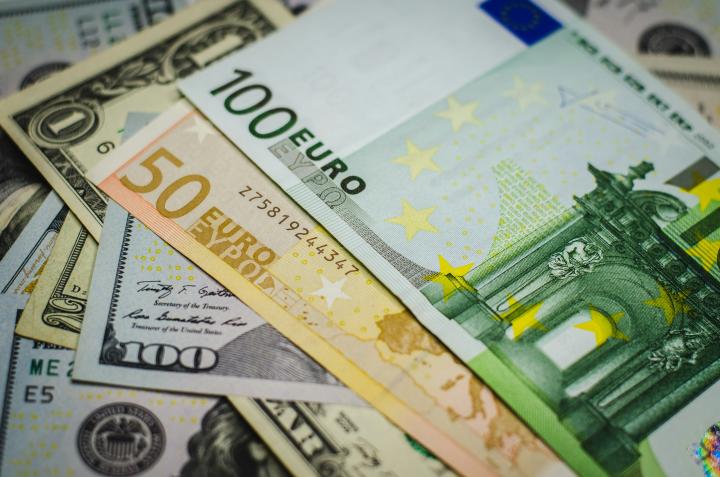
An uptick of volatility in the dollar is forcing European investors to confront an awkward choice. With hedging already expensive, some are paying up to protect against further weakness. Others are opting to take the risk, arguing the bulk of the adjustment may already be behind them.
Last week, the dollar took a breather after more than a year of declines. Following sharp falls in gold and silver prices, the currency rebounded to 0.85 euro from around 0.83 euro, a level last seen in 2021. Support came from the Federal Reserve, which left interest rates unchanged, and from President Donald Trump, who put forward Kevin Warsh as the next chair of the US central bank system. Investors see Warsh not as a political marionette, but as an orthodox, data-driven choice.
Investors are nonetheless “bracing for another leg lower in the dollar if macro conditions or US policy start to turn against it,” said Chris Turner, global head of markets and currency strategist at ING. The cost of insuring against euro strength climbed last week to 1.3 percentage points, up from just 0.14 percent in mid-January, highlighting growing unease over the dollar. The greenback is making market participants increasingly nervous about their concentration in US assets, and there is “no clear sign” of a broader mood shift yet, he told Investment Officer.
The dollar has weakened almost consistently against the euro since October 2022, a move that accelerated with the start of Trump’s second term. The president has long been sceptical of a strong dollar, arguing it puts US companies at a disadvantage versus foreign rivals, particularly Chinese and European exporters. Speaking in Iowa last week, Trump said he was “OK” with the dollar losing value, echoing a long-standing US view captured by the phrase: “The dollar is our currency, but it’s your problem.”
The weaker dollar is already reshaping returns for European investors. Dollar exposure proved a powerful tailwind in previous years, but that support faded in 2025. Measured in euros, the S&P500 delivered a total return of just under 4 percent last year, compared with a gain of almost 18 percent in dollar terms. If the greenback continues to lose ground, unhedged US assets could weigh on performance again this year.
That dynamic is particularly uncomfortable for fixed-income investors. “When USD appreciation ceased, the free lunch evaporated,” said Pramol Dhawan, who manages emerging market strategies at PIMCO. For years, currency gains helped offset low yields for foreign buyers of US Treasuries. With that tailwind gone, rising hedging costs mean some European investors are earning less than their domestic risk-free rates.
According to Dhawan, that creates a structural problem. “If a fully hedged US Treasury delivers less than what investors can earn at home, the trade no longer makes economic sense,” he wrote in a note on Linkedin. US Treasury data already shows foreign investors reducing bond holdings while rotating toward equities, a shift Dhawan describes as more than short-term noise.
He also warns that the dollar’s role in portfolios may be changing. Historically driven by interest-rate differentials, the currency is becoming more correlated with equities, weakening its traditional function as a stabiliser during periods of market stress. “Instead of dampening portfolio risk, dollar exposure now amplifies it,” Dhawan said.
Back to normal
Jim Tehupuring, a director at Dutch asset manager 1Vermogensbeheer, broadly agrees that the dollar’s slide has changed the investment landscape, but argues the move so far looks more like normalisation than the start of a disorderly downturn.
Over the past two decades, the euro-dollar exchange rate has averaged around 1.20, close to current levels. From that perspective, Tehupuring says the recent weakness does not yet justify dramatic action. “A few years ago the dollar was exceptionally strong,” he said. “What we are seeing now is largely a return toward the long-term average.”
Tehupuring does not rule out further dollar weakness and says the currency could fall another 5 to 6 percent this year. But he sees limited value in hedging at a time when volatility has pushed up the cost of protection. “Hedging is simply expensive right now,” he said. “If you can tolerate the currency risk in your portfolio, it often makes more sense to accept it.”
Instead of using currency hedges, Tehupuring has adjusted portfolio allocations. His firm is underweight US assets and overweight Europe, while also holding a larger allocation to precious metals as protection against geopolitical and inflation risks. The approach reflects caution toward the dollar without making a directional bet on a deeper decline.
For euro-based investors, he added, perspective matters. “Some years the dollar works for you, other years it doesn’t,”