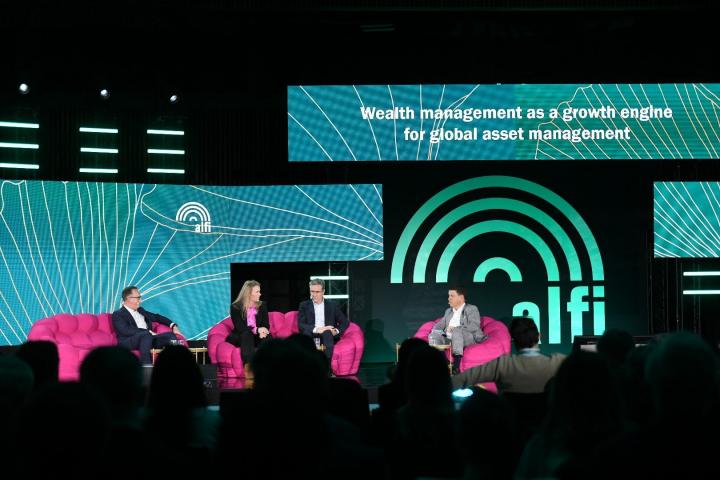
For years, Luxembourg has been where funds are domiciled, administered, and reported on, while the actual investment decisions got made elsewhere. That may be shifting.
Luxembourg is moving, slowly but surely, from being a back-office location to one with front-office roles, said Raphaël Eber, partner & continental Europe CEO at the multi-family office Stonehage Fleming, speaking at Alfi’s annual Global Asset Management Conference in Kirchberg on Wednesday. For Eber, the question isn’t how Luxembourg maintains its competitive edge. It’s how the grand duchy creates one.
“From what I can see, the usual model has been: we have the traders and portfolio managers in New York and London, and we have the back-office in Luxembourg,” he told Investment Officer after the panel.
Now, “it starts to be more friendly for companies to set up an investment management platform in continental Europe,” continued Eber, and when looking around for a jurisdiction, “Luxembourg looks to be the right one.” A newly-passed carried interest regime, which taxes fund managers’ performance fees at rates well below those in London or Paris, is part of what’s making that case.
Boosting the country’s attractiveness
Applicable as from the 2026 tax year, the reform has provided legal certainty and distinguishes between two types of carried interest. The maximum effective tax rate for contractual carried interest comes to approximately 11.45 percent. For participation-linked carried interest, where the participation does not exceed 10 percent of the fund’s capital and is held for more than six months, the income may benefit from a full personal income tax exemption, according to Luxembourg for Finance. The scope of beneficiaries has also been broadened.
With Luxembourg’s financial sector highly dependent on investment funds and asset management, “this reform aims to maintain international competitiveness,” attract skilled financial professionals, and establish front-office teams, said Hugues Hénaff, partner at Atoz Tax Advisers Luxembourg, speaking during a session dedicated to regulatory updates.
Other financial centres like Milan and Dublin, Hénaff pointed out, already have attractive carried interest tax regimes in place. “It is also important to bear in mind that the carried interest regime can be combined with the impatriate regime, and also—depending on the level of salary—with the cap on social security contributions, making this a nice package in case of relocation.”
Though it’s difficult to have a comprehensive overview, Atoz has already observed “a number of relocations to Luxembourg from London or Paris” since the end of last year. “And given that it has been winter and Luxembourg still does not have a seaside, one may reasonably assume that this new regulation has been taken into account in the context of these changes of residence.”
Finance minister Gilles Roth, who delivered a keynote at the Alfi conference Tuesday, also mentioned that the Luxembourg government has reduced the corporate income tax rate by one percentage point and added that this will be lowered again in 2027.
Boredom as asset
Hannamari Koivikko, executive director, wealth advisor at J.P. Morgan Luxembourg, emphasized that the grand duchy’s stability must not be underestimated. “Like I usually say to people, the number one export that Luxembourg has is boredom! We really should be concentrating on that,” she told Investment Officer. “That is a rare gem to have. Not that much happens, and if something happens, it’s usually positive. There’s development happening in this country.”
“The number one export that Luxembourg has is boredom! That is a rare gem to have.”
Hannamari Koivikko, J.P. Morgan
Trust is absolutely essential, added Eber. It’s the “trustworthy” asset manager that will still be here 20 years down the line. “If you don’t have trust, you cannot build in the long run.”
That trust is crucial when working with wealthy families and preparing for trillions of euros in assets to be handed over to the next generation. As Eber put it during the panel, the time horizon for wealthy families is not just two to three years. Instead, they’re thinking about how to transmit their money and preserve their family values over the coming decades. With families now often spread across multiple countries, their situations become increasingly complex from a regulatory, tax, and legal perspective.
Tech for collaboration
The relationship between wealth managers and asset managers has also evolved. Today, more than ever, it’s important for them to provide a smooth experience for clients. “In the past, the asset managers were really product factories. The wealth managers controlled distribution. And the value exchange was basically shelf space and access,” said Alan Goodrich, sales director at ERI, which provides banks, wealth managers, custodians, and fund administrators with advanced software, speaking during a panel.
“That is really changing now,” he argued, thanks to three major market forces: investors and their expectations; the technology that is now available; and competition between asset managers. In the future, he expects that “asset managers will have to provide technology platforms that become embedded in the advisory journey, which will be API-driven.” Clients will be able to have multiple portfolios on a platform that they can customize according to risk appetite, performance goals, or ESG preferences, for instance.
“There will be, from a technology point of view, a coming-together between the asset managers and the wealth managers,” said Goodrich. And with clients expecting a “seamless experience,” as described by Koivikko, they expect that asset and wealth managers work together.
Technology, too, can play a role in driving growth for asset and wealth managers, and for Luxembourg overall. “At the end of the day, technology is there to support the business,” said Goodrich. Beyond collaboration between asset and wealth managers, collaboration within organisations is becoming much stronger and broader in scope, he argued.
Technologists can serve as a bridge between “portfolio engineers” and those who are client-facing, and on top of this “donut,” you can “sprinkle” some data scientists, fiscal experts, and a little AI to make things more efficient. “Technology is embedded into everything,” said Goodrich, “but the whole process of delivering to the customer is becoming much more collaborative.”
But trust is seen as the foundation of this “donut with sprinkles.” “I think it’s also important for all of us to understand what exactly it is that we are doing with this technology,” said Koivikko. Even if we put sprinkles on the donut, it’s better to understand what the dough is made of. “In essence, we all—in this room—have only one product that we can sell, which is trust. There’s no other thing that’s on the market.”