
Here in Milan, during the Olympic Games, only one thing matters: winning. In geopolitics, the battle for victory has now been pushed to an unprecedented level. But whether we in rustic Europe are truly aware of that, I wonder.
“Taking part is more important than winning.” An extremely sympathetic statement, once formulated by Pierre de Coubertin, the founder of the modern Olympic Games, the first of which were held in 1896 in, how could it be otherwise, Athens. As beautiful as the message may be, reality is radically different. The Olympic Games are about winning. And about nothing else.
On the geopolitical stage, the battle is fiercer than I can remember. And there, too, there is only one objective: to win. Whether it concerns rare resources, sometimes hidden in until recently insignificant peninsulas, knowledge, or technology, it has become a race to see who gets there first and who secures the most.
You would expect Europe, hardly blessed with all of the above, to step on the gas in order to compete for victory. But that has been disappointing.
When I see Ursula appear in yet another country she is visiting, she seems primarily occupied with reaffirming the wonderful relationships we have. Whether she truly realizes how rapidly the playing field is changing is something I have my doubts about.
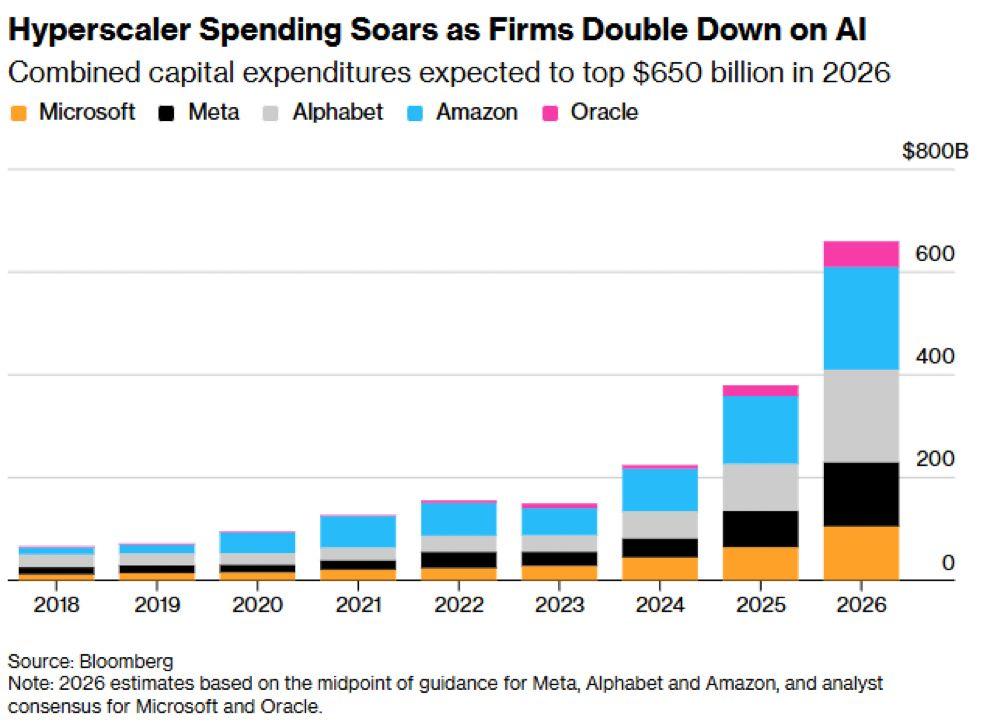
A telling example of where Europe has so far missed the boat is AI. After the presentation of last year’s quarterly earnings, one thing became clear: whoever does not invest in AI falls behind. The so-called hyperscalers presented one astronomical figure after another being invested in AI technology, data centers, and everything that comes with it.
The question is whether all those investments will pay off. My suspicion: not fully. And judging by market reactions, investors are beginning to wonder whether this will all work out.
I do not think so. And that means companies with little debt will ultimately outperform, because they will not, or at least to a lesser extent, be burdened by a potential AI investment bubble.
What stands out most is that European companies are barely in the game. The hyperscalers are already so far ahead, and through their massive investments they are only widening that lead. If only because the investment threshold keeps rising. I hear few concrete ideas about how Europe intends to close this gap. Or how we can benefit from the AI investment wave by building applications, infrastructure, or supply chains here.
Why are we not trying to get a second ASML off the ground? I regularly hear that company’s CEO say that growth in the Netherlands is being constrained, not that he sees unlimited room to accelerate.
Of course, you do not close such a gap overnight. But what I miss in Ursula and other policymakers is the will to win.
Since quite a few of them will undoubtedly make an appearance in Milan, perhaps they can draw some inspiration there about what it takes to defeat a competitor.
Greetings from Milan
Jeroen Blokland analyzes eye-catching, current charts on the financial markets and the macroeconomy. In addition, he manages the Blokland Smart Multi-Asset Fund, a fund that invests in stocks, gold, and bitcoin.