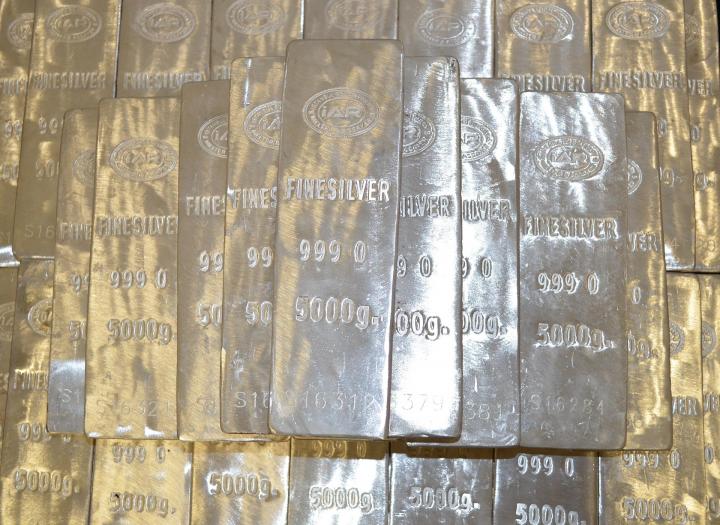
The silver price appears to be breaking with its traditional pattern. Where the metal has historically followed gold with a delay, silver is now moving more independently and at a faster pace. According to market participants, the recent rally is less a reaction to geopolitical tensions than the result of structural changes in the balance between supply and demand.
Strong industrial demand from China, alongside global investment in artificial intelligence and data centres, is playing a central role.
Silver prices have tripled over the past 12 months to 96 dollars per troy ounce (31.1 grams), edging closer to the psychologically important level of 100 dollars. For a market that spent much of the past decade struggling to stay above 30 dollars, the move is exceptional. Over the same period, gold prices have risen by a comparatively modest 75 percent.
Not an ETF story
At first glance, the price increase fits the familiar backdrop of geopolitical tensions. Gold has responded as expected. Silver, however, has risen far more strongly than gold. Such an acceleration would normally point to speculative activity, but the data do not support that interpretation.
Shares outstanding in the largest silver exchange-traded fund, the iShares Physical Silver ETC, which has approximately 4.5 billion euros under management, have increased by only around 8 percent over the past year. Futures market positioning also shows no signs of excessive leverage.
Morningstar data shows that silver ETFs in Europe recorded net outflows of roughly 400 million euros in 2023 and were broadly flat in 2024, before turning positive in 2025 with inflows of about 2.2 billion euros. This shows that ETF demand has been intermittent and reactive rather than the primary driver of the silver price rally, Morningstar said.
“It is reasonable to conclude that it is not the ‘traditional’ sources of financial investment that have been driving silver,” Evy Hambro, managing director at Blackrock and global head of thematic and sector-based investing, told Investment Officer.
Supply structurally inflexible
According to Frederik Fischer, senior portfolio manager at Allianz Global Investors, the explanation lies primarily in strong structural demand from China combined with constrained supply.
“We see no positioning data of financial investors, neither CFTC nor western ETF holdings, that could explain the massive movements,” Fischer told Investment Officer. “The silver rally is driven by the physical market.”
On the production side, silver differs fundamentally from gold. Roughly two thirds of global supply is produced as a by-product of copper, zinc and lead mining, according to the Silver Institute. Global silver output has remained largely unchanged since 2020, while demand has exceeded supply for five consecutive years. Annual deficits have consistently exceeded 100 million ounces, leading to a steady decline in inventories.
Gold, by contrast, benefits from substantial above-ground reserves and a relatively elastic supply. Demand is primarily monetary in nature. Silver, meanwhile, is constrained by a mining structure that offers limited capacity to absorb sustained growth in demand. As a result, the market reacts more sharply to shortages.
Industrial demand takes over
That tension is reinforced on the demand side. More than 50 percent of global silver consumption is now industrial, with solar energy alone accounting for around 25 percent of demand.
“Silver stands apart from gold because it also has meaningful industrial applications, particularly in the new energy economy. This is where China comes in,” Kenneth Lamont, principal at Morningstar, told Investment Officer.
China dominates the production of solar panels, batteries and electric vehicles, giving it a decisive influence over silver demand. In addition, the global expansion of data centres is adding to industrial consumption of the metal.
In Shanghai, silver has been trading above London prices for months, at times at a premium of more than 10 percent. Investors appear willing to pay extra for guaranteed physical delivery.
Volatility by design
Exchange-traded products such as ETCs did not cause the price rally, analysts say, but they have reinforced it by withdrawing physical silver from the market.
“It is fair to say that ETF demand is more volatile than industrial demand, or than central bank demand in the case of gold,” Alexandre Carrier, portfolio manager at DNCA, said.
Retail inflows are also supporting prices and amplifying volatility, according to Benoit Harger, portfolio manager at Bank J. Safra Sarasin. “This flow might support silver price and increase the volatility in the market, but fundamentals are likely to be the main drivers,” Harger said.