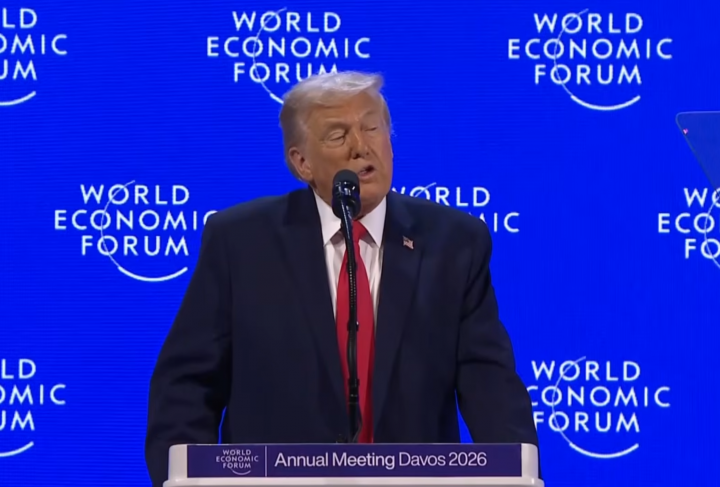
Donald Trump’s return to the Davos stage on Wednesday has sharpened investor focus on Europe’s exposure to a world in which geopolitics is once again shaping trade, security and capital allocation. “Everything has changed,” said Sabrina Khanniche, senior economist at Pictet.
Trump, the only sitting US president ever to visit Davos, reiterated a series of long-standing positions on tariffs, the Federal Reserve and Greenland. Speaking off-the-cuff for more than an hour, Trump said he wanted to open “immediate negotiations” with Denmark over Greenland, framing the issue in security terms.
“What we want from Denmark is this land to build the Golden Dome to keep those missiles away,” Trump said. He ruled out the use of force.
Trump, while insisting that the United States remains committed to NATO, argued that US ownership of Greenland would ultimately strengthen the alliance.
‘Europe is safe’
Trump’s renewed focus on Greenland has strained relations between Europe and Washington in recent weeks and revived questions about the future balance within NATO. The episode has also fed into market discussions about Europe’s concentration risk in US financial assets, at a time when geopolitics is increasingly intersecting with portfolio construction.
Some voices in Europe, including former Dutch armed forces commander Dick Berlijn, have publicly suggested that European countries should consider selling US Treasuries and US equities. European investors currently hold approximately 12,100 billion dollars in US stocks and bonds.
Speaking earlier on Wednesday at a Davos panel, NATO secretary-general Mark Rutte sought to defuse the tension and defended Trump’s approach. “Europe is safe,” Rutte said. “I’m not popular with you now because I’m defending Donald Trump, but I really believe you can be happy that he is there because he has forced us in Europe to step up, to face the consequences that we have to take care of more of our own defence.”
Geopolitics as driver of economic strategy
The exchange captured a broader shift that investors are increasingly forced to confront: geopolitics is no longer a background risk, but a driver of economic strategy. For Sabrina Khanniche, senior economist at Pictet Asset Management, the debates unfolding in Davos confirm a transition Europe can no longer treat as temporary.
 “I think the long period of stability and peace in Europe, which was made possible by strong US support, integration and cooperation, is now over,” Khanniche said in an interview with Investment Officer on Tuesday. “Europe faces challenges and must show it can manage on its own.”
That assessment resonated with remarks elsewhere in Davos. French president Emmanuel Macron warned that the global system is moving towards “a world without rules, where the only law that seems to matter is that of the strongest”. Trade, security and investment, he argued, have become inseparable, requiring Europe to strengthen its economic sovereignty and strategic autonomy.
Traditional growth model dismantled
Khanniche’s analysis reaches the same conclusion, but from an explicitly economic angle. She argues that Europe’s traditional growth model has already been dismantled by recent shocks. “We are moving away from a growth model characterised by US security, cheap energy from Russia and China as the main export market,” she said. “Everything has changed.”
Canada’s prime minister Mark Carney, speaking in Davos on Tuesday, described the shift as structural rather than cyclical. “We are in the midst of a rupture, not a transition,” he said, warning that economic integration is increasingly being used as leverage, with tariffs, supply chains and financial infrastructure becoming tools of coercion.
Khanniche stressed that Europe’s strategic autonomy is not a political slogan but an investment challenge, requiring sustained spending on defence, infrastructure, energy resilience and technology.
In that context, Germany has become a focal point. “German fiscal stimulus is a clear paradigm shift,” Khanniche said. “After many years of underinvestment driven by fiscal constraints, this changes how we need to look at Europe.”
“I don’t think you need to have everything in place for Europe to become a positive story. But unless Europe addresses its structural rigidities, it will be difficult to continue to outperform.”
Sabrina Khanniche, Pictet
Germany’s shift has reopened debates about fiscal flexibility and common European capacity, issues that have long constrained Europe’s response to external shocks. In Davos, Macron called for faster investment, regulatory simplification and deeper capital market integration, arguing that Europe remains too slow in mobilising its own savings.
Khanniche agrees that structural constraints remain decisive. “We know what the missing parts are: capital markets union, fiscal capacity and labour mobility,” she said, adding that without progress on these fronts, Europe’s ability to sustain higher growth will remain limited.
Diversifying away from the U.S.
From an asset allocation perspective, Khanniche says investor behaviour is already adjusting. “There is still a willingness among investors to diversify away from the U.S. and to look at Europe more closely,” she said, pointing to interest linked to defence spending, infrastructure renewal and strategic industrial sectors.
Asked whether ‘diversification’ is becoming a euphemism for selling US assets, Khanniche did not dismiss the idea. “It could be,” she said, while stressing that any shift is likely to be gradual rather than abrupt. In her view, geopolitical uncertainty, the use of tariffs as leverage and concerns about institutional politicisation in the US are prompting investors to reassess concentration risk, rather than triggering wholesale exits.
Khanniche believes Europe’s revival is possible, but far from automatic. “I don’t think you need to have everything in place for Europe to become a positive story,” she said. “But unless Europe addresses its structural rigidities, it will be difficult to continue to outperform.”
She adds that the current geopolitical environment may also bring Europe closer to confronting one of its most sensitive unresolved questions. “What I see now is the potential to revive the debate on joint debt,” Khanniche said. “That debate is now easier.”