Political nervousness is rising over the potential victory of the far right in the French presidential elections of April 2027, as that could lead to less European integration. But the Investment Centre at ING Belgium currently sees no reason to adjust its investment policy.
Investors were focused on Wednesday on the possible early departure of Christine Lagarde as head of the European Central Bank, following a report in the Financial Times. She would reportedly be willing to step down earlier than planned, allowing French President Emmanuel Macron and German Chancellor Friedrich Merz to appoint her successor before the French presidential elections.
This cannot be seen separately from recent polls in which RN leader Marine Le Pen, and especially her protégé Jordan Bardella, are scoring well as potential successors to Macron, who is no longer eligible to run. The 30-year-old Bardella even ranks number 1 in several polls.
Rassemblement National is a strongly nationalist and euroskeptic party. The reporting in the Financial Times suggests that the European establishment is concerned about an RN president. Lagarde herself said in response that she has not yet made a decision about the end of her term. The news outlet Politico previously reported that Macron is pushing through a whole series of appointments domestically to preempt a possible RN triumph.
Frexit?
Should investors take into account an anti-European French president who, in extreme scenarios, might consider France leaving the European Union or the eurozone. The Investment Centre at ING Belgium is not currently concerned about a possible “Frexit.”
Chief investment strategist Vincent Juvyns gave two reasons. “We see no movement in the French-German yield spread, so at this moment there is no sign of risk aversion toward France,” he said during a press meeting. “And unlike in the past, Le Pen no longer says she wants to take France out of the eurozone. So even if RN were to come to power, we do not have to fear a Frexit. In the short term, there is no acute risk to the end of the euro.”
“There is no acute risk to the end of the euro”
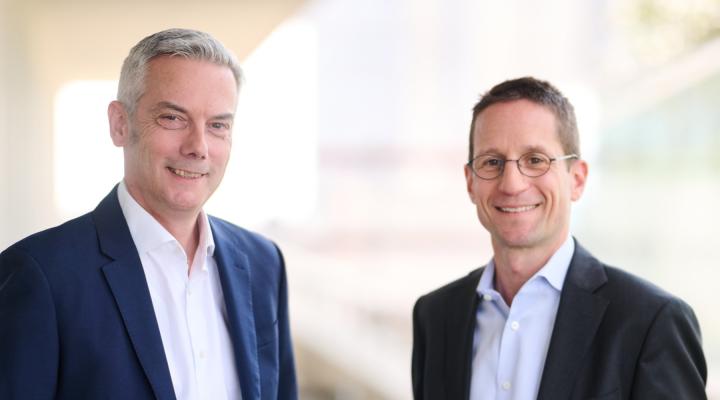
Vincent Juvyns, chief investment strategist ING Belgium
According to the investment center, what is needed is not less, but more European integration and cooperation to stimulate economic growth in the EU. “We fully support the EU’s ambition to create a savings and investment union (SIU),” it said. Parent group ING recently brought together the Investment Offices of Belgium, the Netherlands, and Luxembourg into a Global Investment Centre, effectively giving it a European footprint in practice.
Reindustrialization
Chief investment officer Frédéric Degembe also welcomes Europe’s ambition to reinvent itself industrially. At last week’s European summit in Antwerp and Alden Biesen, European heads of state and European Commission President Ursula von der Leyen promised to give new momentum to capital markets union and to restore the competitiveness of Europe’s declining industry.
That comes none too soon, said Degembe. He believes we should not be blinded by the recent rise in European equities. “If European equities are performing well in the market today, it is because of their attractive valuations, and not because of dynamism in Europe,” he said.
“If European equities are performing well in the market today, it is because of their attractive valuations, and not because of dynamism in Europe”
Frédéric Degembe, chief investment officer ING Belgium
Juvyns also believed the rise in European equities should be put into perspective. The Dutch tech giant ASML has already risen 23 percent this year. “It is more of an anti-tech and anti-US move than an expression of Europe performing strongly.”
Doubts about Germany
While other financial experts expect Germany’s stimulus policy to give the rest of the eurozone an energy boost, Juvyns is less enthusiastic.
“For us, Germany is not a gamechanger in the way a savings and investment union would be. Germany may have emerged from recession, but the problems have not disappeared. Tellingly, the number of unemployed has risen again above 3 million people.”
“Germany’s fundamental problem remains its lack of competitiveness. Higher investment in defense may be positive for individual companies such as Rheinmetall, but does it also increase Germany’s overall productivity. That is questionable. In addition, the auto industry, which is important for Germany, is also facing structural problems, including competition from China.”