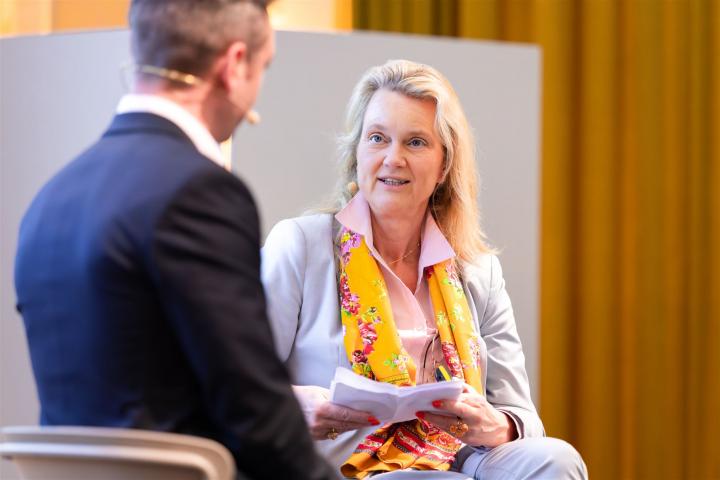
The conflict in the Middle East hit financial markets less hard than expected. Rabobank strategist Mary Pieterse-Bloem sees in that not just relief, but a risk.
Mary Pieterse-Bloem had expected a bigger blow.
When the war broke out, the head of investments at Rabobank Private Banking called a crisis meeting. Sunday. Later that day the team published a note on the bank’s website and app that was read by more than 23.000 people. Monday morning, markets fell by around 3 percent for the MSCI in euros.
“I instantly felt in my tummy: this is big,” she said, speaking on Thursday at the Morningstar Global Insights event. “I had expected a much bigger drawdown in equities.”
Her explanation is uncomfortable. Investors are growing accustomed to geopolitical shocks. Ukraine. Gaza. Now this. Each crisis produces a shorter, milder market reaction than the one before. Those who bought the dip after Liberation Day last year were rewarded. That lesson is now deeply ingrained.
“The psychological element of markets should not be underestimated,” said Pieterse-Bloem. “Unfortunately there is a certain getting-used-to-all-this effect.”
That effect has a name in investment circles: the Trump put. The assumption that markets will always be cushioned before the damage gets too large. With tariffs, that logic held. A president can reverse tariffs. A war is different.
“With tariffs, you can sort of switch them on and off unilaterally from a United States perspective,” she said. “With the war, he dropped his bombs and then it was out of his control.”
Fertiliser as a blind spot
Rabobank placed the oil price at the centre of its crisis analysis from the start. Understandable. Oil is embedded in transport, production and logistics. What the team initially underestimated were the second and third-order effects.
Fertiliser turned out to be one of the blind spots. “I’m a super economist, not a chemist,” said Pieterse-Bloem, “but I was told that gas is one of the ingredients for producing a type of fertiliser that is used very broadly around the world.” Rising gas prices therefore translate not only into higher energy bills, but into higher food costs.
“Oil price spikes, oil, gas, fertiliser, are going to creep into the prices of almost everything that we buy,” she said. “A hairdresser may not need oil or gas directly, but his shampoo does.”
Institutional investors, she warned, are still insufficiently accounting for those knock-on effects. The direct price shock is visible. The pass-through into broader consumer prices comes more slowly, but is no less real for that.
Asymmetric risk
Three weeks into the conflict, Rabobank reduced its equity weighting in discretionary portfolios from mildly overweight to neutral. Not as a profit warning, but as risk management.
The logic is straightforward. If the conflict resolves quickly, the room for market recovery is limited since markets have already priced much of the war in. If downside risks materialise, through structural damage to oil facilities or prolonged supply disruption, the potential decline is considerably larger.
“That again presents an asymmetric buying opportunity,” she said, referring specifically to inflation-linked bonds, which in her view remain underpriced. The five-year, five-year forward inflation expectation in the US is barely higher than before the war broke out. One of the more striking anomalies in the current market, she noted.
The temporary ceasefire that sent markets sharply higher yesterday does not reassure her. Her market economist in London called it a “sneeze-fire.” Pieterse-Bloem used the term approvingly.
Fragile. One sneeze and it is over.
(This article has been updated to correct the number of people mentioned in the third paragraph.)