As global leaders and investors arrive in Davos this week, the central question for markets is no longer whether geopolitics matters, but how quickly political risk is being priced into assets. Donald Trump’s return to the World Economic Forum, where he is due to speak on Wednesday, comes at a moment when institutional credibility, fiscal discipline and capital concentration have become investment variables rather than background noise.
The last time Trump attended Davos in person, in January 2020, the world was on the brink of a pandemic that would soon expose the fragility of the global economic order. His return in 2026 comes in a different but no less unstable environment. The US president arrives as the dominant force in global politics, determined to pursue economic and foreign policy on explicitly transactional terms.
For investors, the implications extend beyond the headlines. What stands out ahead of Davos is not the scale of political disruption, but the extent to which markets continue to trade through it. Several large allocators warn that this disconnect may prove temporary.
Political risk mispriced?
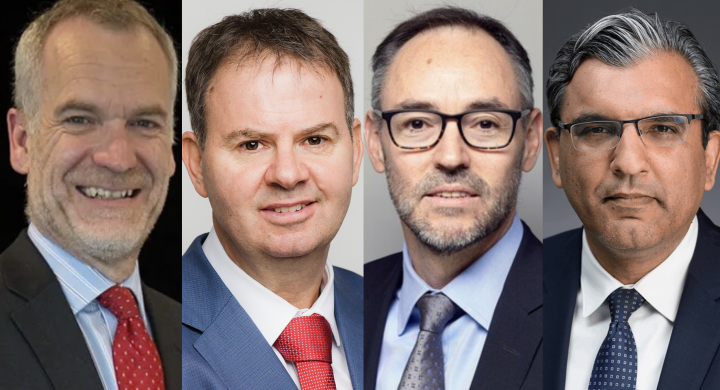
“Financial markets have remained surprisingly calm in the face of a flurry of initiatives from the Trump administration,” Paul Jackson, global head of asset allocation research at Invesco, told Investment Officer. He sees the move in precious metals as an early warning rather than a sideshow. “If the reaction in gold and silver is correct, I would expect to eventually see a bigger reaction in US treasury yields up, the dollar down and US equities down, with volatility indices such as the VIX rising.”
The warning matters because it comes from an allocator rather than a political analyst. Jackson is effectively arguing that political risk is being mispriced, and that any repricing is likely to be broad and abrupt.
That concern is echoed in equity markets. “While driven by market forces, the concentration of global financial assets in the US arguably represents a market failure that warrants a policy response,” said Michael Krautzberger, chief investment officer public markets at Allianz Global Investors. The implication, he argued, is that Europe’s challenge is not a shortage of savings. The real gap is the absence of fully integrated capital and banking markets capable of pooling risk, scaling investment and offering credible alternatives to US assets.
Europe enters Davos facing a challenge that markets are no longer willing to treat as theoretical. The transatlantic relationship has shifted from alliance management to permanent uncertainty. US policy has become less predictable, more confrontational and more openly dismissive of multilateral constraints. Europe, by contrast, remains politically fragmented and fiscally cautious, without a settled strategy for dealing with a US president who questions climate commitments, pressures the Federal Reserve and treats security guarantees as bargaining chips.
The question hanging over Davos is no longer diplomatic. It is financial: can Europe remain investable in a world where geopolitical risk increasingly expresses itself through balance sheets, currencies and risk premia?
From diplomacy to balance sheets
For years, European policymakers framed Trump as a disruption that could be managed through dialogue and delay. That assumption has eroded. The debate ahead of Davos is now more direct: who bears the cost of strategic autonomy, how quickly capital can be mobilized for defense and energy security, and how much uncertainty markets will tolerate before demanding compensation.
That shift is reflected in the World Economic Forum’s Global Risks Report 2026 released ahead of the meeting. For the first time, geoeconomic confrontation has overtaken armed conflict as the most acute short-term global risk. Trade policy, investment restrictions and control over strategic resources are now seen as primary tools of rivalry, with direct consequences for supply chains, capital flows and asset pricing.
The report also highlights a widening tension between short-term geopolitical confrontation and longer-term systemic risks. Climate change, biodiversity loss and the governance of artificial intelligence remain among the most severe threats over the next decade. Yet they are increasingly crowded out by immediate political competition, raising the risk of policy error.
Institutional risk moves center stage
Nowhere is that tension clearer than in fixed income markets. “Record defense budgets, expanding industrial policy and rising populism will compel major economies to run historically high deficits,” said Guillermo Felices, global investment strategist at PGIM Fixed Income. “Accompanying demands for low policy rates may impact central banks’ inflation-fighting credibility, and repriced term premia will increasingly determine long-term rates.”
The risk, Felices argues, is not confined to the United States. Persistent pressure on the Federal Reserve, combined with loose fiscal policy, could lead to overheating and higher long-term rates, with spillovers into European assets. Geopolitical miscalculations could further increase pressure on Europe to raise defense spending, adding to upward pressure on yields.
More troubling for long-term investors is the possibility that institutional stress becomes structural. Felices points to recent US Department of Justice actions involving the Federal Reserve as a sign of potential fraying in institutional norms, a development that could justify a higher risk premium on US assets, a weaker dollar and a steeper Treasury curve.
Davos scoped for signals, not solutions
Davos will not resolve these tensions, but it will offer signals. Investors will be watching whether political ambition is matched by fiscal realism, whether security is treated as an economic variable, and whether institutional guardrails are reinforced or weakened. They will also listen closely to Trump’s words, not for grand strategy but for hints of pressure on the Federal Reserve or fresh geopolitical escalation.
The next test will follow quickly. In February, the Munich Security Conference will again place the transatlantic relationship under scrutiny.
“Trump’s return to Davos exemplifies the coming of the new age of deglobalization,” said Salman Ahmed, global head of macro and asset allocation at Fidelity International. “This new environment will be fundamentally more volatile and inflationary as supply of raw input and material becomes a more binding constraint. As a result, increasing strategic allocations to real assets like gold, infrastructure and commodity-focused equities is likely to enhance portfolio resilience without sacrificing performance.”