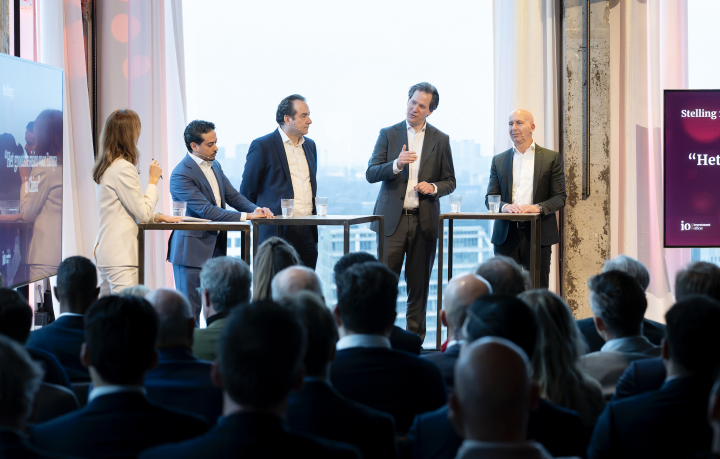
Anyone following geopolitical tensions, the noise around China and the ongoing turmoil coming out of Washington might expect investors to turn defensive. The opposite emerged at the CIO panel during the Investment Officer New Year’s Perspectives 2026 in Amsterdam.
Chief investment officers from ING, Van Lanschot Kempen, ABN Amro and Rabobank are not retreating, but positioning with intent. Their shared view was that the greatest risk is not geopolitics itself, but investment decisions driven by fear. That perspective ran through the discussion.
Europe’s internal risk
Richard de Groot, chief investment officer at ABN Amro, gave that view concrete form by pointing to Europe’s own shortcomings. “Europe itself is the biggest risk for Europe,” he said, referring to weak coordination and limited joint action. External threats matter less, he argued, than Europe’s inability to act decisively. “Taking action remains very difficult.”
Bob Homan, chief investment officer at ING Investment Office, strongly agreed. Europe, he said, too often traps itself in pessimism. Looking ahead to 2026, he described the year as “uncertain, tough and challenging.” Precisely for that reason, he warned against inaction: standing still out of fear is not a strategy.
Discipline over geopolitics
Despite the uncertainty, the tone was not pessimistic. The CIOs see scope for returns, provided investors remain disciplined. De Groot noted that the economic starting position remains solid. “From an economic perspective, we are in good shape,” he said. Pieter Heijboer, chief investment officer at Van Lanschot Kempen, echoed that assessment and urged investors to avoid reacting to daily noise. They should “not become unsettled by the headlines,” but stick to a consistent allocation.
Geopolitics, the panel agreed, mainly acts as a source of volatility unless it feeds through into the real economy. Taoufik Boussebaa, chief investment officer at Rabobank, warned against overreacting. “As long as those signals do not feed through, geopolitics will mainly fuel volatility,” he said. His broader message was one of resilience. “Do not underestimate the adaptive capacity of companies and governments.”
China and diversification
China was discussed in a notably nuanced way. Boussebaa described Chinese policy as “consistent and predictable,” contrasting it with policy uncertainty in the United States. Heijboer rejected the idea that China represents the dominant risk. “China is not the greatest danger,” he said, while acknowledging concerns around dumping and export dependence. Homan went further, explicitly calling China investable. “China interesting to invest in? I think so,” he said, citing low valuations and broad exposure to artificial intelligence.
That geopolitical backdrop translates into a clear strategic implication: reduce dependence on a narrow group of US technology stocks. De Groot warned about the “heavy weighting in indices,” which he described as “sometimes worrying.” Diversification beyond the so-called magnificent seven is becoming increasingly important.
AI demands selectivity
Artificial intelligence remains the dominant investment theme, but requires selectivity. Homan pointed to sharp differences within equity markets. “The dispersion within equities is large, with clear winners and losers,” he said. Companies using AI to cut costs stand to benefit, while others face structural pressure. “Consultancy, marketing, publishers… their business models are genuinely threatened by AI.”
Heijboer added that some AI companies are becoming increasingly capital-intensive. “They are taking on a lot of debt,” he said, making them “less attractive for investors.”
Boussebaa stressed that AI opportunities extend beyond software. He pointed to “physical AI, robotics, sovereign AI” and to evidence of structural demand. “The TSMC report is a clear signal of fundamental demand,” he said. TSMC, the world’s largest chip manufacturer, recently reported continued strong demand for advanced chips heading into early 2026. At the same time, Boussebaa does not see a repeat of the dotcom era. “A bubble like the 1990s? No.”
Equities remain the core of portfolios despite the risks. Homan described interest rates as “not such a big issue” and said earnings and growth are “doing quite well,” while cautioning that elevated equity valuations imply a risk premium that should not be ignored.
Within equities, attention is shifting towards sectors that benefit from the rate environment. Banks were cited by several CIOs as attractive. “We find banks interesting, even US banks,” Boussebaa said. Emerging markets are also back on the radar. “Emerging markets still have legs,” he noted, particularly in debt. De Groot highlighted currency risk as a key factor. “What will happen to the dollar?” he asked, stressing the need for active management.
Private markets
Private markets remain part of the toolkit, but selectively. Heijboer highlighted private credit, infrastructure and real assets as income-generating options, while setting limits. “Ten to twenty percent at most,” he said. Boussebaa emphasised that private assets only make sense if they “really fit the client.” De Groot underlined the trade-off. “You have to accept that liquidity is not there.”
Finally, the panel noted renewed interest in sustainable investing. Homan said ESG has “fallen somewhat out of favour,” but sees opportunity in that shift. “There is now genuine undervaluation,” he said, pointing to wind and solar energy.