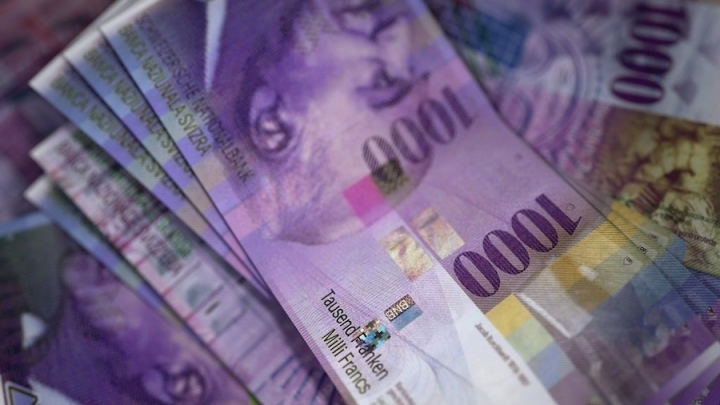
The sharp rise in the Swiss franc following U.S.–Israeli strikes on Iran has brought an issue back into focus that many believed had been settled: negative interest rates in Switzerland.
The Swiss National Bank resorted to verbal intervention on Monday after the franc surged against the euro, pushing the currency toward levels last seen during the 2015 franc shock.
The SNB said that recent international developments had increased its readiness to intervene in foreign exchange markets. It added that it is “prepared to intervene in the foreign exchange market to counter a rapid and excessive appreciation of the Swiss franc, which jeopardises price stability in Switzerland.”
The euro fell to 0.9037 francs in early trading, its weakest level since January 2015, before recovering to around 0.9119 francs following the SNB’s statement.
Market rate already below
The context is notable. Since June of last year, the SNB’s official policy rate has stood at 0.00 percent. Yet short-term market rates are already slightly negative.
As of late last week, the Swiss Average Rate Overnight, or SARON, was hovering around -0.08 percent.
SARON is the central benchmark for Swiss franc money markets. Published daily by SIX Swiss Exchange, it reflects the cost of collateralized overnight lending in the Swiss repo market. The rate sits at the core of Switzerland’s financial system, influencing the yield curve, banks’ liquidity management, and the transmission of monetary policy.
Negative rates as a last resort
Nadia Gharbi, senior economist at Pictet Wealth Management, said verbal intervention may only be the first step if geopolitical tensions intensify.
“The SNB has reiterated its readiness to act to dampen rapid and excessive appreciation of the franc, even in the face of pressure from the U.S. administration,” she said in a written comment. “The threshold for reintroducing negative policy rates is high; the SNB would consider this option only in a more adverse scenario, such as if the global economy nears recession and the franc continues to strengthen, necessitating further monetary policy easing.”
Switzerland maintained negative policy rates for years in an effort to counter excessive capital inflows and currency strength. A return to that framework would signal both persistent appreciation pressure and a deteriorating global outlook.
Inflation and export pressures
Christian Schulz, chief economist at Allianz Global Investors, said the franc’s rise adds further downward pressure on inflation and challenges Swiss industry, even if households benefit from stronger purchasing power through cheaper imports.
“Further appreciation is clearly unwelcome for the SNB,” Schulz told Investment Officer. “While FX interventions can help smooth abrupt movements, a prolonged and substantial rise in the franc could even force the SNB to consider rate cuts, despite the very high bar for returning to negative territory.”
In an extreme scenario, he added, Switzerland’s exchange-rate framework could re-enter the policy debate, although reinstating a euro peg would be politically and economically difficult after its abrupt abandonment in 2015.
Euro weakness
While the franc has strengthened, the U.S. dollar has also gained on safe-haven flows.
“Given the heightened geopolitical uncertainty, we expect currencies that are historically considered safe havens, such as the U.S. dollar and the Swiss franc, to strengthen, while more risk-sensitive emerging-market currencies may weaken,” said Xueming Song, currency strategist at DWS, in a note to investors.
The euro’s weakness reflects both capital flows and Europe’s economic exposure. On Monday, Dutch TTF gas futures for April delivery jumped nearly 50 percent to 47 euros per megawatt hour, highlighting how quickly geopolitical risk feeds into European energy pricing.
Since replacing Russian pipeline gas with global LNG imports, the European Union has become more dependent on maritime supply routes and dollar-denominated energy trade. In 2025, the EU imported more than 140 billion cubic meters of LNG, with the United States supplying nearly 58 percent, according to Bruegel data.