
India is drawing fresh interest from global investors as domestic demand, rapid digitalization and a deepening capital market give it resilience few major economies can match. Emerging market specialists say these qualities are becoming increasingly relevant for diversified portfolios.
Alessia Berardi, head of emerging macro and strategy at Amundi, said India’s investment appeal stems from its shifting internal dynamics. “India is a real domestic story,” she told Investment Officer. “The engine of growth is internal demand, not the global cycle. Consumption is resilient, capital expenditure is strong and the reforms we have seen are supporting both households and corporates. That is why profit growth remains solid and why correlations with the rest of the world stay relatively low.”
Growth drivers
India continues to expand faster than other large economies. Headline GDP growth of around 8 percent may overstate the underlying trend, but potential growth of 6 to 7 percent still places the country at the top of global rankings.
International institutions are drawing similar conclusions. The IMF describes India’s reform trajectory, including the lower Goods and Services Tax (GST), inflation targeting and digital public infrastructure, as having “laid a strong foundation for sustained growth.” Demographically, India’s working-age population is expected to grow by more than 140 million over the next two decades, a notable contrast to aging major economies.
GST reforms have also placed about 95 percent of goods into lower tax brackets. Berardi said this frees household income equivalent to 0.3 to 0.4 percent of GDP growth, helping offset the impact of 50 percent trade tariffs imposed by President Donald Trump, one of the highest tariff rates faced by any country in the world.
Market behavior
India’s diversification value stems from how differently its markets behave. Amundi said both equities and government bonds have shown relatively low correlation with global benchmarks, an uncommon feature in emerging markets. With goods exports representing roughly 20 percent of GDP, the economy remains less exposed to global trade cycles than export-led Asian peers. Domestic demand remains the main growth engine.
At the same time, production-linked incentives continue to attract investment in electronics, autos, defense and chemicals, laying the groundwork for a potential multi-year private-sector capex cycle. Both Amundi and Allianz have noted that the expansion of digital infrastructure, spanning payments, identity and data rails has broadened financial inclusion and supported rising domestic retail flows.
Structural shift
The broader structural story is drawing attention beyond public markets. Allianz economist Yu Zhang argued that India is entering what could become a “virtuous economic cycle” lasting two decades, backed by persistent GDP growth, a labor force representing roughly two-thirds of the population, rapid digital adoption and mobile data usage approaching 20 gigabytes per person per month. That combination, he said, puts India on a course to outperform its East Asian predecessors in both scale and sustainability.
A younger generation of Indian entrepreneurs and a growing commitment from multinational manufacturers add to this shift, with companies such as Apple expanding their presence as global supply chains adjust to new geopolitical conditions, according to Zhang.
Improved access
Meanwhile, access to India’s markets is becoming easier. The inclusion of Indian sovereign bonds in the J.P. Morgan GBI-EM index since last year, where they are expected to account for 10 percent, is likely to attract additional inflows over the coming years.
Access for foreign investors is also improving. India’s international financial center in the state of Gujarat, known as GIFT City, is helping lower operational and tax frictions. Set up as a financial hub competing with Dubai or Singapore, it offers a regulatory framework, tax incentives and AI infrastructure aimed at attracting international banks, asset managers and capital-markets businesses, and provides an onshore-offshore bridge for foreign institutions seeking fewer administrative hurdles.
India is often described as a potential beneficiary of global “China-plus-one” strategies, in which multinationals diversify production away from China to reduce geopolitical and supply-chain risk. Berardi argues that this framing does not capture India’s own policy priorities. The country’s manufacturing drive, she said, is rooted chiefly in domestic economics rather than in an attempt to replace China as an export platform. “Eventually, that can turn to exports, but before that, it is the domestic demand that needs to be satisfied.”
Allocations
Asked about allocations, Berardi said she favors equities and government bonds over corporate credit. Large caps stand out for earnings visibility and governance quality.
In Zhang’s analysis, several companies illustrate how India’s corporate landscape is developing. Travel platform MakeMyTrip has grown into a domestic counterpart to Booking.com, capturing the shift toward digital consumption. Airline group IndiGo has built a profitable low-cost model in a market that is still expanding rapidly. Consumer sectors are evolving as well. Brands such as MyCar and Wrangler are benefiting from steady growth in automobile demand.
Private markets are also drawing attention. At a recent LPEA conference in Luxembourg, Vaishnavi Gurumurthy of EAAA Alternatives, an Indian private markets firm, described India’s shift from a bank-dominated system to one where private lenders play a growing role in infrastructure and growth finance. “We’re providing 12 to 18 percent dollar returns, with significant collateral and strong governance,” she said, adding that bankruptcy reforms and steady growth are helping private debt move “from niche to mainstream.”
India’s Nifty 50 stock index set record in November
but underperformed other emerging market equity indices
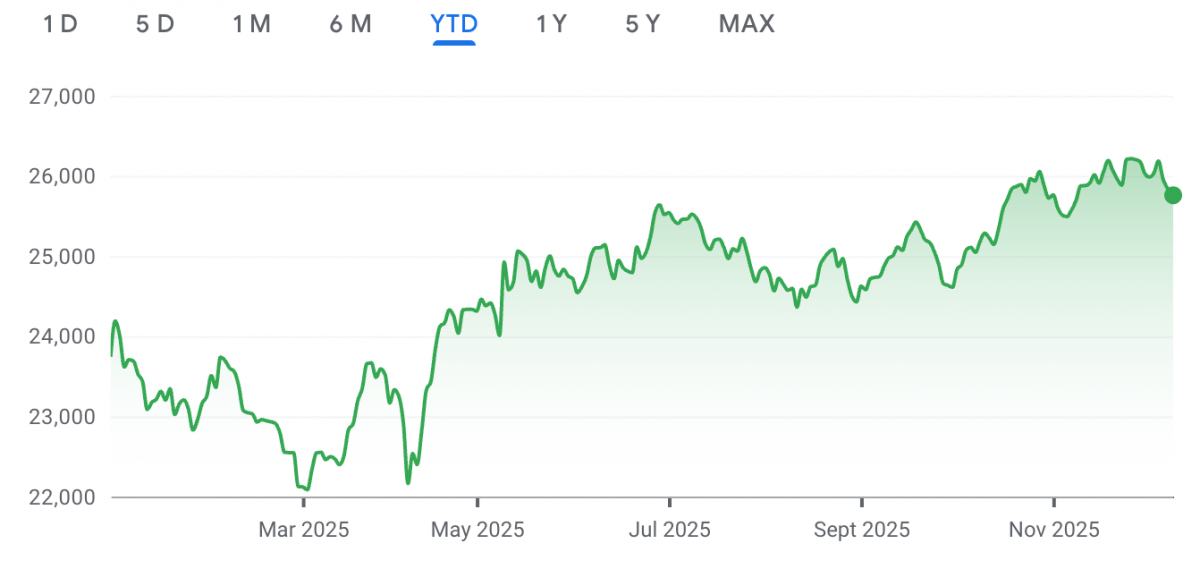
Source: Google.