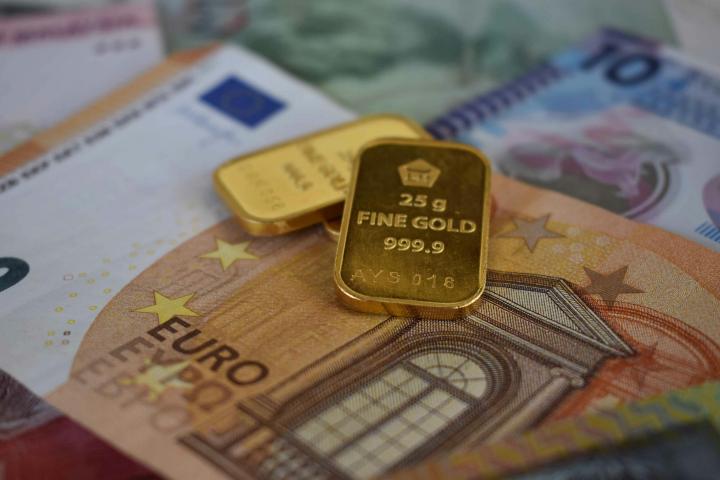
Strong demand for gold from central banks and the relatively small position held by private investors in the precious metal will push the gold price higher in 2026, Carmignac expects. Even so, the asset manager has slightly reduced its allocation to gold.
This emerged during Carmignac’s annual meeting in Paris last week. Multi-asset investor Jacques Hirsch of the 8.4 billion euro flagship fund Patrimoine emphasized, during a discussion on Carmignac’s current asset allocation, the importance of commodities in a portfolio, and within that, gold.
Hirsch placed his view on commodities against the backdrop of “a changed nature of economic policy, retreating central banks, and aggressive fiscal policy by governments.” “Take the United States: unemployment is relatively low, around 4.5 percent, but at the same time the budget deficit amounts to roughly 6 percent of gdp, which is historically a very high level.”
Because expansionary fiscal policy supports nominal growth, Carmignac has held relatively high equity positions for two years. And because large budget deficits also lead to heavy bond issuance, the firm maintains a low duration in its portfolios. A third starting point of the current portfolio construction is that bonds currently provide less diversification relative to equities. As a result, investors need to “shift to other assets, such as gold and commodities.” “This is also because commodities have historically been the big winners during geopolitical tensions, and within commodities that is gold.”
Rise in the gold price
In 2025, the gold price climbed from just over 2,600 dollar to above 4,500 dollar per troy ounce (31.1 grams). According to Hirsch, the precious metal could rise further this year, although he does not specify a particular upper limit. He points to demand for gold from central banks, which is expected to remain high. “Last week, the Polish central bank announced that it will buy 150 tons of gold. That is 4 to 5 percent of global mine production. Very significant.”
Hirsch found a second reason in the investment portfolios of private investors, which according to the fund manager contain relatively “little” gold, at least less than in 2022, he said, referring to assets held in gold ETFs. “A more technical observation is that we do not see classic signs of euphoria in the mining sector. There are no mega-mergers, capital expenditures remain limited, and valuations are still reasonable. That is why we remain exposed to gold, although that exposure is slightly lower than before.”
Patrimoine invests in gold through mining companies, with Carmignac’s investors focusing on companies in “stable jurisdictions,” such as North and South America, and on companies with low production costs.
Copper
Among other metals, Carmignac finds copper attractive. Hirsch said: “Mine production has struggled to grow in recent years. There have been serious incidents at certain mines, including in Congo. At the same time, demand continues to rise, driven by global economic growth and by new applications related to AI. In addition, Donald Trump’s trade policy plays a role, as it has reoriented large copper flows. That has fundamentally changed the market balance.”
The equity exposure of Carmignac’s Patrimoine fund currently stands at around 38 percent, with a focus on healthcare, financials, and technology. Duration is virtually zero, and in terms of currencies the Carmignac flagship is focused on commodity exporters and emerging markets.
In 2025, Patrimoine achieved a return of 13 percent, compared with 1.1 percent for the benchmark index. Over a three-year period, the fund is up nearly 28 percent, versus just over 21 percent for the index.